The internet has come a long way—from the static, read-only websites of the early days to the dynamic, interactive platforms we use every day. But a new era is unfolding, and it’s changing the rules of the game.
Enter Web3—a decentralized version of the internet built on blockchain technology. It promises to give users real ownership of their data, digital assets, and online identity. If Web1 was about reading, and Web2 was about reading and writing, then Web3 is about owning.
But what is Web3? How did we get here? And why does it matter? In this guide, we’ll walk you through all aspects of the Web3 era. Let’s dive in.
The Evolution of the Internet: From Web1 to Web3
To truly understand what Web3 is and why it’s making waves, we need to take a step back and explore how the internet has evolved. The web has gone through multiple phases — each representing a major shift in how we create, share, and control information online. These phases are often referred to as Web1, Web2, and Web3.
Web1: The Read-Only Web
Web1 refers to the earliest stage of the internet, which existed roughly from the 1990s to the early 2000s. During this time, websites were mostly static and informational. The average internet user could browse pages and read content, but interaction was extremely limited.
Key characteristics of Web1:
- Static HTML pages with no dynamic content.
- No login systems or user profiles.
- Centralized ownership of content.
- Very few content creators, mostly just readers.
Web1 was like a giant online library — full of information but offering no way to participate or contribute.
Web2: The Read-Write Web
Web2 began around the mid-2000s and continues to define much of today’s internet. This era introduced interactive, user-generated content, and social networking. Platforms like Facebook, YouTube, Twitter, and Instagram empowered users to publish their own content — but with a catch.
Key characteristics of Web2:
- Social media and content-sharing platforms dominate.
- Users can create and share content, but don’t own it.
- Platforms collect and monetize user data.
- Centralized systems control access and moderation.
While Web2 created the “creator economy”, it also raised concerns around data privacy, platform control, and censorship. In Web2, users are the product — their data fuels massive advertising businesses.
Web3: The Read-Write-Own Web
Web3 is the next major evolution of the internet. It’s built on decentralized technologies like blockchain and aims to give users control over their data, digital identity, and online assets. Instead of relying on centralized platforms, users interact directly with decentralized applications (dApps) and protocols.
Key characteristics of Web3:
- Built on blockchain for transparency and decentralization.
- Users truly own their digital assets and identities.
- Token-based systems incentivize participation and contribution.
- Decisions can be made collectively through DAOs (Decentralized Autonomous Organizations).
In Web3, the power shifts away from corporations and toward users. It’s about creating an internet that is owned, governed, and shaped by the people who use it — not by a handful of tech giants.

Read more: Web2 vs Web3: What Sets Them Apart?
What is Web3?
Web3 (also known as Web 3.0) is the next evolution of the internet — a decentralized, user-owned version of the web powered by blockchain technology. It aims to fix some of the core problems of Web2, such as centralized control, data exploitation, and lack of ownership. Instead of platforms owning everything, Web3 gives users control over their identity, data, and digital assets.
Unlike today’s web, where tech giants act as middlemen and profit from user-generated content, Web3 enables people to interact directly using decentralized applications (dApps). These apps run on public blockchains — open, transparent systems where data can’t be easily altered or censored.
One of the defining features of Web3 is ownership. In Web2, you log in with an email address or social media account, and everything you post or create is technically controlled by the platform. In Web3, your identity is tied to a blockchain wallet — and anything you earn, buy, or build truly belongs to you. Whether it’s cryptocurrency, an NFT, or your profile in a digital community, ownership is in your hands.
Web3 also introduces token-based systems that reward users for their participation. Instead of giving away your time and data for free, you can earn tokens that have real value — and sometimes even help you vote on how a platform is governed, thanks to DAOs.
Ultimately, Web3 represents a vision for a more democratic and user-centric internet — one where privacy is protected, control is decentralized, and everyone has the chance to participate in shaping the future of the web.

Table: How Web3 Differs from Web2
| Feature | Web2 | Web3 |
| Ownership | Platforms own user data | Users own their data and digital assets |
| Control | Centralized platforms make decisions | Governance by community via smart contracts |
| Identity | Email or social logins | Blockchain wallets (e.g., MetaMask) |
| Monetization | Platforms earn from user activity | Users can earn directly via tokens/NFTs |
| Security | Prone to data breaches | Cryptographic security, no single point of failure |
Core Components and Technologies of Web3
Web3 is more than just a buzzword — it’s an ecosystem built on a set of innovative technologies that enable decentralization, transparency, and user ownership. These core components work together to form the foundation of a new kind of internet.
Blockchain
At the heart of Web3 is blockchain — a distributed ledger that records transactions in a secure, transparent, and tamper-proof way. Unlike traditional databases controlled by a central authority, blockchains are maintained by a decentralized network of nodes. This ensures data integrity and enables trustless interactions between users.
Blockchains like Ethereum, Solana, and Avalanche are used to build decentralized applications (dApps), host smart contracts, and store digital assets.
Read more: Blockchain Social Media: What It Is and 5 Best Platforms
Cryptocurrencies and Tokens
Cryptocurrencies are the native currencies of blockchains. They power Web3 ecosystems by enabling peer-to-peer transactions without banks or payment processors. Examples include Bitcoin (BTC), Ethereum (ETH), and many others.
Beyond currencies, tokens serve many functions in Web3:
- Utility tokens give access to specific services.
- Governance tokens allow holders to vote on project decisions.
- Security tokens represent ownership in real-world assets.
- Social tokens are issued by individuals, communities, or brands to build engagement, reward loyal supporters, and unlock exclusive experiences.
These tokens are central to incentivizing users and decentralizing control.
Smart Contracts
Smart contracts are self-executing programs that run on the blockchain. They automatically carry out actions when certain conditions are met, eliminating the need for intermediaries.
For example, in a Web3 marketplace, a smart contract could handle payments and digital ownership transfers when both buyer and seller agree — all without relying on a third-party platform.
Smart contracts play an important role in DeFi. Learn how it works with the article: DeFi Smart Contracts: How They Work & Why They Matter.
NFTs (Non-Fungible Tokens)
NFTs represent unique digital assets that can’t be replicated or exchanged one-for-one like cryptocurrencies. They are widely used for digital art, gaming items, music, virtual real estate, and even identity credentials.
With NFTs, creators can prove ownership, earn royalties on resales, and interact directly with their communities — all enabled by blockchain technology.

DeFi (Decentralized Finance)
DeFi is a movement within Web3 that recreates traditional financial systems (like lending, borrowing, and trading) using blockchain and smart contracts. With DeFi, users can access financial services without relying on banks or brokers.
Platforms like Uniswap, Aave, and Compound offer open, permissionless alternatives to traditional finance — often with better transparency and user control.
Looking for tips and platforms to invest in DeFi? Check out these articles:
Decentralized Storage & Identity
To make Web3 truly decentralized, it needs alternatives to centralized cloud storage and login systems.
- Storage: Protocols like IPFS (InterPlanetary File System) and Arweave offer distributed, permanent, and censorship-resistant file hosting. They’re used to store website content, NFT metadata, and blockchain data in a secure and decentralized way.
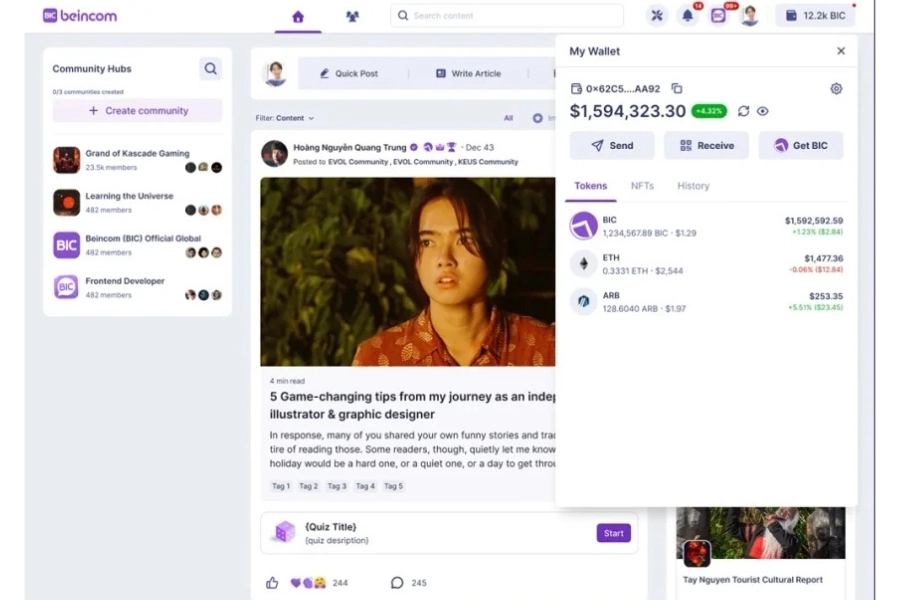
- Identity: Solutions like Ethereum Name Service (ENS), Lens Protocol, and Beincom give users self-sovereign identities tied to their blockchain wallets. These identities can be used across dApps, making Web3 login seamless and privacy-respecting.
Wallets and Interfaces
Web3 wallets act as both identity and access points. They enable users to interact with dApps, manage tokens, and sign transactions — all while maintaining control over their data.
Popular examples include:
- MetaMask – a browser extension wallet for Ethereum and EVM-compatible chains
- Coinbase Wallet – a user-friendly mobile wallet integrated with Coinbase
- Ledger – a hardware wallet offering cold storage for maximum security
These tools form the bridge between users and the decentralized web, making Web3 more accessible and secure.
DAOs (Decentralized Autonomous Organizations)
DAOs are blockchain-based organizations governed by code and community. Instead of executives and boards, DAOs operate through smart contracts and collective voting using governance tokens.
DAOs are being used to manage protocols, fund projects, curate NFT collections, and even run investment funds — all transparently and democratically.
These building blocks are what make Web3 possible. Together, they create a system where trust is built into the code, ownership is digital and portable, and anyone can participate — no matter where they are in the world.
Benefits of Web3
Web3 promises to transform the internet experience by addressing many limitations of the current Web2 model. By leveraging decentralization, blockchain technology, and token-based economics, Web3 offers several key benefits that empower users and redefine online interactions.
- True Ownership and Control: Users fully own their digital assets, identity, and data, rather than centralized platforms controlling or monetizing them.
- Enhanced Privacy and Security: Decentralized networks reduce risks of data breaches and censorship, while cryptographic methods protect user information.
- New Economic Models and Incentives: Tokenization enables creators and communities to monetize their contributions directly, rewarding engagement without middlemen.
- Interoperability and Open Standards: Users can easily move assets and identities across platforms, reducing vendor lock-in and fostering a collaborative ecosystem.
- Decentralized Governance: DAOs and governance tokens empower communities to participate in platform decisions, increasing transparency and fairness.
Real-World Applications of Web3
Web3 technologies are already reshaping various industries and creating new opportunities for users and businesses alike. Some of the most exciting real-world applications include:
Finance: Lending, Borrowing, Staking
Decentralized Finance (DeFi) platforms enable users to lend, borrow, and stake cryptocurrencies without intermediaries. This open financial ecosystem provides access to loans, interest earnings, and yield farming opportunities, democratizing finance for users worldwide.
Gaming: Play-to-Earn, On-Chain Assets
Web3 gaming allows players to truly own in-game assets as NFTs and earn rewards through gameplay. Titles like Axie Infinity pioneered play-to-earn models, where players can monetize their time and skills within decentralized game economies.
Social Media: Decentralized Platforms
Decentralized social networks such as Lens Protocol and Farcaster give users control over their data and content. These platforms reduce censorship and enable content monetization directly between creators and their communities.
This emerging model, often called SocialFi, combines social networking with decentralized finance, allowing users to earn tokens for their participation, content creation, and community engagement.
Read more: Top 10 Breakthrough SocialFi Platforms to Watch in 2025
Art & Creativity: NFTs and Royalties On-Chain
Artists and creators use NFTs to authenticate digital art and music, ensuring provenance and enabling automatic royalty payments on secondary sales through smart contracts. This creates sustainable income streams and fosters a direct creator-to-fan relationship.
Supply Chains: Transparent Tracking via Blockchain
Blockchain technology enhances supply chain transparency by securely tracking products from origin to delivery. This reduces fraud, ensures product authenticity, and improves consumer trust, especially in industries like food, pharmaceuticals, and luxury goods.
Identity & Credentials: Self-Sovereign Identity (SSI)
Self-sovereign identity solutions empower users to own and manage their digital identities without relying on centralized authorities. This improves privacy, simplifies authentication, and enables users to selectively share credentials across services securely.
Learn the difference between Layer 1 and Layer 2 to better understand how blockchains work here.
Challenges and Criticisms of Web3
While Web3 offers promising innovations, it also faces several challenges and criticisms that impact adoption and development:
- Scalability Issues: Many blockchain networks struggle with slow transaction speeds and high fees, limiting Web3’s ability to support mass adoption and complex applications.
- User Experience Barriers: Web3 interfaces and wallets can be confusing for newcomers, creating a steep learning curve compared to familiar Web2 platforms.
- Regulatory Uncertainty: Governments worldwide are still figuring out how to regulate cryptocurrencies, tokens, and decentralized platforms, creating legal risks and ambiguity for users and developers.
- Environmental Concerns: Some blockchain networks rely on energy-intensive consensus mechanisms like Proof of Work, raising sustainability issues. However, newer protocols are adopting more eco-friendly solutions.
- Security Risks: While blockchain is secure by design, scams and phishing attacks remain common, posing risks to users and projects.
- Centralization in Decentralization: Despite aiming for decentralization, some Web3 projects still rely heavily on centralized infrastructure or developers, leading to concerns about true decentralization.
- Speculation and Hype: The rapid rise of tokens and NFTs has led to speculative bubbles, misinformation, and unrealistic expectations, which can undermine trust in Web3.
Understanding these challenges is crucial for users and developers to navigate Web3 responsibly and help shape its future.
Looking for tips to stay safe in the Web3 era? Check out our guide: Private Key Best Practices
The Future of Web3
Although still in its early stages, Web3 holds great promise to transform the internet and society. We can expect improvements in scalability and user experience through innovations like Layer 2 solutions and better wallet designs, making Web3 more accessible to the general public. Interoperability will improve, allowing seamless interaction across different blockchains and platforms.
Decentralized identity systems will become widespread, giving users greater control over their personal data and simplifying authentication. DeFi will continue to grow, offering more advanced financial products and potentially blending with traditional finance.
Web3 will also drive the expansion of metaverse platforms and virtual economies, creating immersive digital spaces where people can socialize, work, and earn. Governance through DAOs will become more robust, fostering transparency and community-led decision-making.
Lastly, clearer regulatory frameworks are expected to emerge, helping balance innovation with user protection.
While challenges remain, the momentum behind Web3 suggests a transformative future where users regain control, creativity thrives, and new possibilities emerge.
Join the Web3 Revolution with Beincom
Beincom is a SocialFi platform that seamlessly combines the best of Web2’s user-friendly social experience with the innovation of Web3. It streamlines your digital journey, giving real value back to users through BIC tokenomics, NFTs, and community-driven rewards.
With Beincom and the BIC ecosystem, you don’t just use the internet—you own your data, your identity, and your digital assets.
Whether you’re a creator, investor, or everyday user, Beincom offers a simple yet powerful way to participate in the future of the decentralized web.
Join Beincom and be part of the Web3 revolution today.
FAQs
Q1. What is Web3?
Web3 is the next generation of the internet that emphasizes decentralization, user ownership, and blockchain-based technologies. It aims to give users more control over their data, identity, and digital assets.
Q2. How is Web3 different from Web2?
Unlike Web2, which is dominated by centralized platforms controlling user data, Web3 uses decentralized networks and blockchain technology to empower users and reduce reliance on intermediaries.
Q3. What are some core technologies behind Web3?
Key technologies include blockchain, cryptocurrencies and tokens (including social tokens), NFTs, decentralized finance (DeFi), decentralized storage, and user-owned digital identities.
Q4. How can I get started with Web3?
You can start by creating a Web3 wallet (e.g., MetaMask), trying out decentralized apps (dApps), or joining platforms like Beincom that combine Web2 familiarity with Web3 benefits.
Q5. What are tokens used for in Web3?
Tokens can represent currency, voting power (governance tokens), access (utility tokens), ownership (security tokens), or even social influence (social tokens).
Q6. Is Web3 the same as crypto?
Crypto is part of Web3, but Web3 is broader. It includes decentralized finance (DeFi), NFTs, decentralized social platforms, and more.
Q7. Is Web3 safe to use?
Web3 offers more control and security for users, but it’s important to be cautious—use trusted wallets, protect your keys, and avoid scams.
Q8. What’s next for Web3?
The future of Web3 includes better scalability, easier tools, decentralized identity, and more real-world applications across finance, gaming, and social platforms.