DeFi platforms are changing the game in finance — letting users trade, lend, borrow, and earn without needing middlemen. From automated yield strategies to decentralized exchanges, these platforms are at the heart of the growing decentralized finance movement.
In this guide, let’s discover the best DeFi platforms in 2025 and what makes them unique — so you can start navigating this powerful, open financial system with more confidence.
Uniswap

Uniswap is a leading decentralized exchange (DEX) built on the Ethereum blockchain. It enables users to swap ERC-20 tokens directly from their wallets without relying on centralized intermediaries. Utilizing an automated market maker (AMM) model, Uniswap facilitates peer-to-peer trading through liquidity pools, allowing for seamless and permissionless transactions.
Key Features:
- Automated Market Maker (AMM): Uniswap employs a constant product formula (x * y = k) to maintain liquidity pools, enabling users to trade tokens without the need for order books.
- Permissionless Trading: Anyone with a compatible wallet can trade tokens on Uniswap without registration or KYC procedures.
- Liquidity Provision: Users can contribute to liquidity pools and earn a portion of the trading fees, incentivizing participation and enhancing liquidity.
- Multi-Network Support: While primarily on Ethereum, Uniswap has expanded to other EVM-compatible networks, including Arbitrum, Optimism, Polygon, BNB Chain, and Celo.
- Governance via UNI Token: Holders of the UNI token can participate in protocol governance, influencing decisions on upgrades and fee structures.
Pros:
- Decentralization: Operates without a central authority, enhancing security and reducing censorship risks.
- User Control: Users retain custody of their funds, reducing the risk associated with centralized exchanges.
- Wide Token Selection: Supports a vast array of ERC-20 tokens, providing extensive trading options.
- Earning Opportunities: Liquidity providers can earn fees, creating passive income opportunities.
Cons:
- Ethereum Gas Fees: Transactions can incur high fees during network congestion, potentially deterring smaller trades.
- Price Slippage: Large trades may experience slippage, leading to less favorable exchange rates.
- Limited to ERC-20 Tokens: Primarily supports Ethereum-based tokens, limiting access to assets on other blockchains
Aave

Aave is a decentralized, non-custodial liquidity protocol that allows users to participate as suppliers or borrowers. Suppliers provide liquidity to the market to earn passive income, while borrowers can obtain loans by providing collateral. Originally launched as ETHLend in 2017, Aave rebranded and introduced innovative features that have positioned it as a leader in the DeFi lending space.
Key Features:
- Flash Loans: Aave pioneered flash loans, enabling users to borrow assets without collateral, provided the loan is repaid within the same transaction block. This feature is useful for arbitrage, refinancing, and other advanced strategies.
- Interest Rate Options: Borrowers can choose between stable and variable interest rates, offering flexibility to manage their loan terms based on market conditions.
- High-Efficiency Mode: Optimizes borrowing power for users who supply and borrow correlated assets, such as stablecoins, enhancing capital efficiency.
- Multi-Asset Support: Aave supports a wide range of cryptocurrencies, allowing users to lend and borrow various assets.
- Governance via AAVE Token: Holders of the AAVE token can participate in protocol governance, influencing decisions on new features, risk parameters, and other key aspects.
Pros:
- Decentralization: Operates without a central authority, enhancing transparency and reducing censorship risks.
- User Control: Users retain custody of their funds, reducing reliance on third parties.
- Innovative Features: Introduced unique functionalities like flash loans and high-efficiency mode, setting it apart from other DeFi platforms.
- Security: Undergoes regular audits and has implemented robust security measures to protect user funds.
Cons:
- Complexity: Some features may be challenging for beginners to understand and utilize effectively.
- Risk of Liquidation: Borrowers must maintain their collateral above a certain threshold; failure to do so can result in liquidation, especially during volatile market conditions.
- Ethereum Gas Fees: Transactions on the Ethereum network can incur high fees during periods of congestion, although Aave has expanded to other networks to mitigate this issue.
Curve Finance
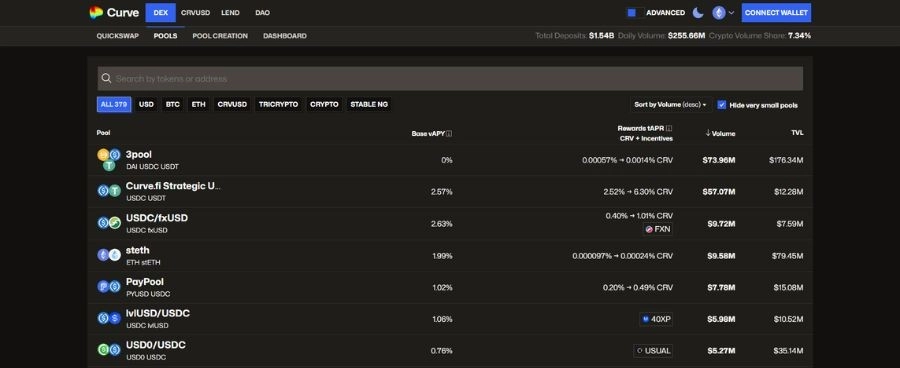
Curve Finance is a decentralized exchange (DEX) launched in 2020, specifically designed for efficient stablecoin trading. By utilizing an automated market maker (AMM) model, Curve enables users to swap stablecoins with minimal slippage and low fees. Its focus on stablecoins and low-volatility assets has made it a cornerstone in the decentralized finance (DeFi) ecosystem.
Key Features:
- Optimized Stablecoin Trading: Curve’s AMM algorithm is tailored for assets with similar values, such as stablecoins, ensuring efficient trades with minimal price impact.
- Low Fees and Slippage: The platform offers some of the lowest trading fees in DeFi, typically around 0.04%, and minimal slippage, making it cost-effective for users.
- Liquidity Pools: Users can provide liquidity to various pools and earn rewards, including trading fees and CRV tokens, enhancing the platform’s liquidity.
- Governance via CRV Token: The CRV token allows holders to participate in the platform’s governance, influencing decisions on protocol upgrades and parameters.
- Layer 2 Integration: To address Ethereum’s scalability issues, Curve has integrated with Layer 2 solutions, improving transaction speeds and reducing costs.
Pros:
- Efficient Stablecoin Swaps: Curve excels in providing low-cost, low-slippage trades for stablecoins, benefiting users seeking efficient asset exchanges.
- Passive Income Opportunities: Liquidity providers can earn consistent returns through trading fees and CRV token incentives.
- Strong Community Governance: The platform’s decentralized governance model empowers users to have a say in its development and policies.
Cons:
- Limited Asset Variety: Curve primarily focuses on stablecoins and similar assets, offering fewer options for trading more volatile cryptocurrencies.
- Complex User Interface: New users may find the platform’s interface and functionalities challenging to navigate initially.
- Dependence on Ethereum Network: While Layer 2 integrations help, the platform’s reliance on Ethereum can still lead to higher gas fees during network congestion.
MakerDAO
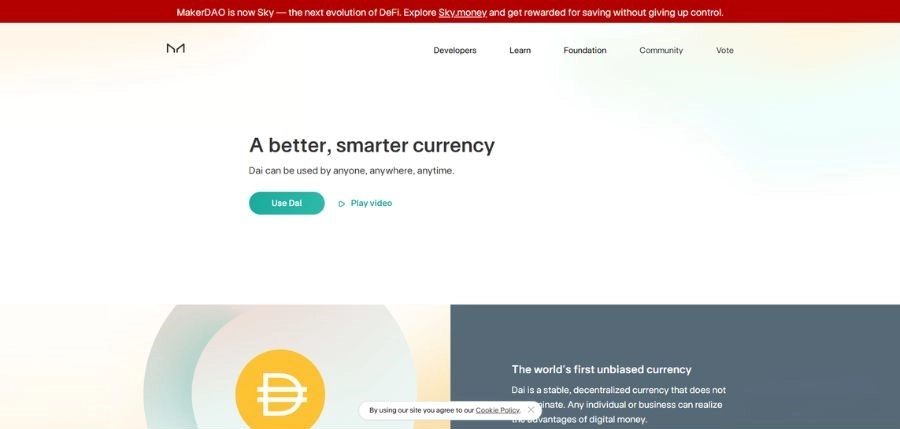
MakerDAO is a decentralized autonomous organization (DAO) that operates the Maker Protocol on the Ethereum blockchain. It allows users to generate DAI, a decentralized stablecoin pegged to the US dollar, by locking up collateral in smart contracts. MakerDAO plays a pivotal role in the DeFi ecosystem by providing a stable medium of exchange and a decentralized lending platform.
Key Features:
- DAI Stablecoin: A decentralized, collateral-backed stablecoin that maintains a soft peg to the US dollar, enabling users to transact with a stable asset in the volatile crypto market.
- Collateralized Debt Positions (CDPs): Users can lock up various cryptocurrencies as collateral to generate DAI, creating a decentralized borrowing mechanism without intermediaries.
- Multi-Collateral Support: Supports multiple types of collateral, including ETH, BAT, and USDC, allowing for diversified risk management.
- Governance via MKR Token: Holders of the MKR token can participate in the governance of the Maker Protocol, influencing decisions on risk parameters, collateral types, and system upgrades.
Pros:
- Decentralization: Operates without a central authority, enhancing transparency and reducing censorship risks.
- Stability: Provides a stablecoin (DAI) that is crucial for various DeFi applications, offering a hedge against crypto volatility.
- Community Governance: Empowers the community to make decisions, fostering a sense of ownership and alignment with user interests.
Cons:
- Complexity: The system’s mechanisms, including CDPs and governance processes, can be complex for new users to understand.
- Collateral Volatility: The value of the collateral can fluctuate, potentially leading to liquidation if the collateral value falls below the required threshold.
- Governance Risks: Decisions made by MKR holders may not always align with the broader community’s interests, posing governance challenges.
Compound

Compound is a decentralized lending protocol on Ethereum that enables users to earn interest or borrow crypto assets without relying on intermediaries. It played a major role in popularizing algorithmic interest rates and yield farming within the DeFi space.
Key Features:
- Algorithmic Interest Rates: Rates automatically adjust based on supply and demand
- cTokens: Users receive cTokens when supplying crypto, which accrue interest over time
- Permissionless Access: Anyone with a compatible wallet can lend or borrow assets
- Governance via COMP Token: COMP holders can vote on upgrades and policy decisions
- Wide Integration: Commonly integrated with DeFi aggregators and dApps
Pros:
- Simple UI: Easy-to-use interface for both beginners and experienced users
- Secure and Trusted: One of the most audited and battle-tested DeFi lending platforms
- Earn Interest + Tokens: Users can earn both interest and COMP incentives
- DeFi Composability: Works well with other DeFi protocols
Cons:
- Limited Token Support: Supports fewer assets than some newer protocols
- Ethereum Gas Fees: High transaction fees during peak network usage
- Governance Participation: Requires technical know-how and substantial COMP to vote
SushiSwap
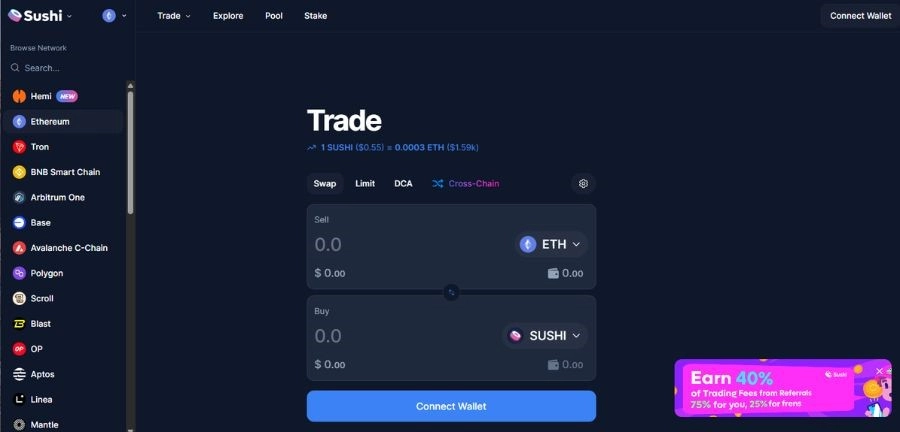
SushiSwap is a decentralized exchange (DEX) built on the Ethereum blockchain that enables users to swap, earn, lend, borrow, and stake crypto assets. It started as a fork of Uniswap but has since evolved into a multi-chain DeFi hub offering a suite of decentralized finance products beyond simple token swaps.
Key Features:
- Decentralized Exchange: Enables token swaps across Ethereum and multiple blockchains
- SushiBar (xSUSHI): Allows users to stake SUSHI tokens and earn a share of platform fees
- Onsen Program: Offers liquidity mining incentives for selected token pairs
- Kashi Lending: A separate lending and margin trading platform
- Multi-Chain Support: Available on networks like Polygon, BNB Chain, Avalanche, and more
Pros:
- Diverse Product Suite: Offers more than just swaps — includes staking, lending, and farming
- Community Governance: SUSHI token holders propose and vote on platform changes
- Multi-Chain Access: Available across several popular blockchains
- Attractive Yield Opportunities: Through SushiBar and Onsen
Cons:
- Past Controversies: Faced early criticism due to anonymous founders and leadership changes
- Complexity: Broader features may overwhelm beginners
Learn more: Crypto Staking Explained: How It Works, Types & Benefits
Balancer

Balancer is one of the typical DeFi platforms that functions as both an automated market maker (AMM) and a portfolio manager. It allows users to create or invest in self-balancing liquidity pools with multiple tokens in customizable ratios. This makes Balancer a powerful tool for DeFi traders and liquidity providers looking to diversify and earn yield.
Key Features:
- Customizable Liquidity Pools: Users can create pools with up to 8 different tokens and custom weightings
- Smart Order Routing: Optimizes trades by finding the best price across multiple pools
- Liquidity Mining: Users can earn BAL tokens by providing liquidity to eligible pools
- Balancer Gnosis Protocol (BGP): A gas-efficient decentralized trading mechanism
- Governance via BAL Token: BAL holders participate in protocol governance decisions
Pros:
- Portfolio Flexibility: Ideal for users who want to maintain specific token ratios in a pool
- Capital Efficiency: Traders benefit from reduced slippage and optimized pricing
- Incentivized Liquidity: BAL rewards encourage active participation
- Permissionless: Anyone can create pools or trade without restrictions
Cons:
- Complexity: Custom pool configurations can be confusing for newcomers
- Impermanent Loss Risk: Still present for liquidity providers in volatile markets
- Gas Fees: High transaction costs on Ethereum mainnet unless using L2 solutions
dYdX

dYdX is one of the typical DeFi trading platforms focused on perpetual contracts, enabling users to trade crypto derivatives with leverage — all without giving up custody of their funds. Built on Ethereum and later migrated to its own Cosmos-based chain (dYdX Chain), it combines the benefits of decentralized finance with the performance of centralized exchanges.
Key Features:
- Perpetual Contracts: Trade perpetual futures with leverage on a decentralized platform
- Order Book Model: Offers a professional trading experience similar to centralized exchanges
- Cross-Margining: Allows users to trade multiple assets with a single margin account
- Decentralized Governance: DYDX token holders vote on protocol upgrades and parameters
- Layer 2 Scaling: Initially operated on StarkWare to minimize gas fees and latency (v3)
Pros:
- Advanced Trading Tools: Offers features like limit orders, stop-loss, and detailed charting
- Self-Custody: Users maintain control of their assets at all times
- Liquidity: High-volume trading supported with competitive spreads
- Decentralized Governance: DYDX holders influence the protocol’s evolution
Cons:
- Complex for Beginners: Best suited for experienced traders
- Leverage Risks: High risk of liquidation for leveraged positions
- Limited Asset Support: Focuses mainly on major cryptocurrencies
Yearn Finance
Yearn Finance is a decentralized yield aggregator that helps users maximize returns on their crypto assets. Launched in 2020 by Andre Cronje, Yearn automatically moves user funds between different DeFi lending and liquidity protocols to find the highest yields, all without requiring users to constantly manage their investments.
Key Features:
- Vaults: Smart-contract strategies that optimize yield farming by auto-compounding and reallocating user deposits across DeFi protocols.
- Earn: Allocates deposited stablecoins to lending platforms like Aave, Compound, and others with the best interest rates.
- Zap: Allows users to enter and exit Yearn vaults using a single token, simplifying complex DeFi actions.
- yCRV Integration: Offers additional strategies using Curve Finance pools to generate yield.
- Governance via YFI Token: YFI holders govern the protocol, deciding on upgrades and strategies.
Pros:
- Automated Yield Optimization: Moves funds to the most profitable platforms automatically, saving time and gas fees.
- Accessibility: Makes complex DeFi strategies available to regular users without requiring advanced knowledge.
- Community-Driven: YFI governance allows users to propose and vote on protocol changes.
- Diversified Strategies: Supports a wide variety of strategies across stablecoins, ETH, BTC, and LP tokens.
Cons:
- Strategy Risk: Automated strategies may not always outperform manual yield farming or adapt to rapid market shifts.
- YFI Token Scarcity: YFI has a limited supply and high value, making governance participation expensive for some users.
- Technical Learning Curve: Despite automation, understanding vaults and their risks may still be difficult for new users.
PancakeSwap
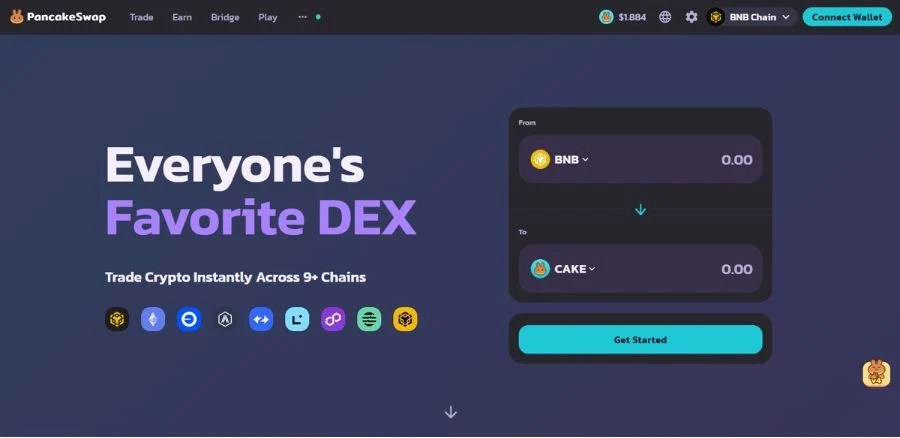
PancakeSwap is a decentralized exchange (DEX) built on BNB Chain (formerly Binance Smart Chain). Launched in September 2020, it offers fast and low-cost token swaps, along with a wide range of DeFi services like yield farming, staking, lotteries, and even NFTs. It’s one of the most user-friendly and feature-rich DeFi platforms, especially popular among beginners.
Key Features:
- AMM-Based Exchange: Uses an automated market maker model to allow users to swap BEP-20 tokens instantly without order books.
- Liquidity Pools: Users can provide liquidity to trading pairs and earn LP tokens and a share of trading fees.
- Syrup Pools: Allows users to stake CAKE tokens and earn more CAKE or other tokens through flexible or locked staking.
- Farms: Offers yield farming by staking LP tokens to earn additional rewards.
- NFT Marketplace: Integrated NFT trading and collectible features within the PancakeSwap ecosystem.
- Lottery & Games: Adds gamified elements like lotteries and prediction markets for user engagement.
- Cross-Chain Functionality: Expands beyond BNB Chain with support for Ethereum and other networks via bridging.
Pros:
- Low Fees: Thanks to BNB Chain, transactions are significantly cheaper compared to Ethereum-based DEXs.
- High Liquidity: One of the largest DEXs by trading volume and liquidity on BNB Chain.
- Wide Range of Features: Offers more than just trading — including games, NFTs, and farming tools.
- Beginner-Friendly: Intuitive interface and guided features suitable for users new to DeFi.
Cons:
- Centralization Concerns: Although decentralized, it’s built on BNB Chain, which is more centralized than Ethereum.
- CAKE Token Inflation: High emissions of CAKE for farming rewards have raised concerns about long-term token value.
- Smart Contract Risks: As with all DeFi platforms, bugs or vulnerabilities in smart contracts could be exploited.
Ready to experience a smarter way to explore DeFi?
Join Beincom — the next-gen social hub and community platform where you can connect, share, and earn while staying updated on the latest in decentralized finance. With $BIC Tokenomics, BIC Wallet, effortless staking, and innovative NFT system, Beincom makes your DeFi journey more secure and social than ever.
Sign up now and be part of the future of decentralized finance!
FAQs
1. What are DeFi platforms?
DeFi platforms are decentralized applications (dApps) that offer traditional financial services — like lending, borrowing, trading, and earning interest — without relying on centralized institutions. They use blockchain technology and smart contracts to function transparently and autonomously.
2. Are DeFi platforms safe to use?
While DeFi platforms are designed to be trustless and transparent, they are not risk-free. Smart contract bugs, protocol hacks, and volatile market conditions can all pose risks. Always research a platform’s reputation, audit history, and user reviews before investing.
3. How do I start using DeFi platforms?
To get started, you’ll need a crypto wallet (like MetaMask or Trust Wallet) and some cryptocurrency (like ETH, BNB, or stablecoins). Simply connect your wallet to the DeFi app and follow its interface to lend, borrow, swap, or stake.
4. Do I need to complete KYC to use DeFi platforms?
Most DeFi platforms are permissionless and don’t require KYC (Know Your Customer) verification. As long as you have a crypto wallet, you can access services globally without ID verification.
5. What are the best DeFi platforms?
Top DeFi platforms include Uniswap (token swaps), Aave (lending/borrowing), Curve Finance (stablecoin trading), MakerDAO (DAI stablecoin), and PancakeSwap (multi-chain trading). Each serves different purposes, so the best one depends on your goals.
6. Can I earn passive income with DeFi?
Yes. Many DeFi platforms offer passive income through staking, yield farming, liquidity provision, and lending. However, returns vary and are subject to risks like impermanent loss or protocol failure.
7. How is DeFi regulated?
Regulation of DeFi is still evolving. Since DeFi platforms are decentralized and globally accessible, they often operate outside traditional regulatory frameworks. However, some governments are beginning to explore legal guidelines for DeFi to address concerns around security, fraud, and compliance.
8. Is Beincom a DeFi platform?
Beincom is not a DeFi protocol itself, but it connects you to decentralized finance experiences with BIC Token. It bridges SocialFi and DeFi by letting users manage tokens, stake, and interact with decentralized services — all while engaging with communities.