In the world of Decentralized Finance (DeFi), liquidity pools power everything from token swaps to yield farming. So, what is a liquidity pool, and why is it important? This guide will cover everything you need to know!
What Is a Liquidity Pool?
A liquidity pool is a collection of crypto assets locked in a smart contract that powers decentralized trading, lending, and many other DeFi functions. It is one of the core foundations of DeFi’s success.
Instead of relying on traditional buyers and sellers to match orders, these pools provide the liquidity in crypto markets that’s essential for seamless transactions — all without the need for a centralized exchange.
In traditional finance, markets operate through order books where buyers and sellers place bids and asks. But in the world of DeFi, decentralized liquidity pools change the game. They allow anyone to become a market maker by simply depositing token pairs (like ETH/USDT) into a pool. These tokens are then used to facilitate trades made by other users on decentralized exchanges (DEXs).
Why does this matter? Because it unlocks 24/7 access to crypto trading across the globe, even for tokens that don’t have deep trading volume on centralized exchanges. Liquidity pools have become a key building block of the DeFi ecosystem, powering platforms like Uniswap, Curve, Balancer, and PancakeSwap.
Whether you’re trading tokens, earning passive income, or building on DeFi protocols, chances are you’re interacting with a liquidity pool behind the scenes.
Read more: What Is a DAO? A Deep Dive into Decentralized Autonomous Organizations
How Do Liquidity Pools Work?
Liquidity pools are the foundation of decentralized trading — allowing users to trade tokens without needing a buyer or seller on the other end. Here’s a closer look at how they function:
Liquidity Providers and Token Pairs
To start, users called liquidity providers (LPs) contribute tokens to a pool. Typically, this involves a pair of tokens, like ETH and USDC, deposited in equal value. For example, if ETH is worth $2,000 and USDC is $1, an LP might deposit 1 ETH and 2,000 USDC into the pool.
In return, the LP receives LP tokens, which represent their share in the pool and their right to claim a portion of the trading fees and deposited assets.
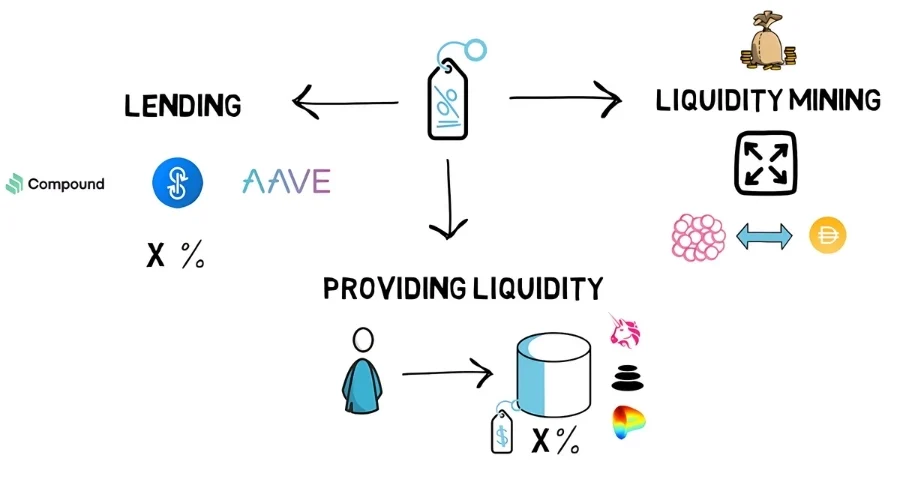
In many DeFi platforms, LPs can also participate in yield farming (also known as liquidity mining). By locking their LP tokens in specific programs, they earn extra rewards — often in the form of the platform’s native token — on top of their regular trading fee earnings. This added incentive has made crypto liquidity pools a major gateway to DeFi yield opportunities.

Automated Market Makers (AMMs)
Liquidity pools rely on automated market makers (AMMs) — smart contracts that use mathematical formulas to price assets based on supply and demand, without needing a centralized order book.
Uniswap, one of the largest decentralized crypto platforms, uses a constant product formula algorithm, which looks like:
x * y = k
Here, x and y are the quantities of two tokens in the pool, and k is a constant. This means as the supply of one token decreases, its price increases — maintaining the balance of the pool.
Let’s say Kevin holds a large amount of UNI tokens and wants to trade them for ETH using a decentralized liquidity pool. The pool holds both UNI and ETH, and it operates on the constant product formula.
When Kevin swaps his UNI for ETH, the balance of tokens in the pool changes — the amount of UNI increases, and the ETH supply decreases. To keep the product constant (k), the AMM increases the price of ETH and decreases the price of UNI. In short: the more Kevin trades, the more expensive ETH becomes for him.
This system guarantees that Kevin can always make his trade — even if the amount is large. But the tradeoff? Price slippage. Since Kevin is placing a big order, he ends up paying a higher average price for his ETH compared to the broader market.
After Kevin’s trade, the pool is now UNI-heavy and ETH-light, causing the internal exchange rate to diverge from the open market. That’s where arbitrage traders come in.
They take advantage of the price gap by adding ETH to the pool and removing the now-undervalued UNI. These trades bring the pool’s pricing back in line with the broader market — all without a centralized market maker.
Trading and Earning Fees
When someone wants to swap tokens — say, trading ETH for USDT — they interact directly with the pool. The AMM determines the price based on the pool’s current balances.
Each trade includes a small fee (usually around 0.3%), which is distributed among all LPs in proportion to their pool share. This creates a passive income opportunity for liquidity providers.
Beyond Basic Pools
Some protocols, like Balancer and Curve, offer advanced liquidity pools that allow:
- More than two tokens in a pool
- Custom token ratios
- Dynamic pricing algorithms
- Incentives from DeFi projects (e.g., bonus tokens for early LPs)
These innovations give users more flexibility and opportunities in decentralized liquidity pools.
Benefits of Liquidity Pools
Liquidity pools play a crucial role in the DeFi ecosystem — not just in enabling trading, but in creating a more open and accessible financial system. Here are some standout benefits:
Constant Liquidity
Unlike traditional order books, crypto liquidity pools provide continuous access to liquidity, even during volatile market conditions. This means users can trade 24/7 without relying on a buyer or seller being present.
Anyone Can Earn
By contributing assets to a pool, anyone — not just institutions — can become a liquidity provider and earn passive income through trading fees and potential yield farming rewards. No need for complex financial setups or intermediaries.
Foundation for DeFi Products
Liquidity pools don’t just power DEXs. They’re also used in lending protocols, synthetic asset platforms, and yield aggregators. Their flexibility makes them a foundational building block in decentralized finance.
Decentralized and Transparent
All transactions within a pool are governed by smart contracts. That means no centralized party can control the liquidity or manipulate prices, and everything is auditable on-chain.
Risks of Liquidity Pools
While liquidity pools offer many benefits, they also come with unique risks that users should carefully consider before contributing funds.
Impermanent Loss
One of the most talked-about risks is impermanent loss. This occurs when the price ratio of the pooled tokens changes compared to when you first deposited them.
If one token’s value rises or falls significantly, you might end up with fewer assets (in dollar value) than if you had just held the tokens separately. It’s “impermanent” because the loss may reduce if the prices return to their original ratio — but that doesn’t always happen.
Let’s break this down with an example in both numbers and context:
Suppose you provide liquidity by depositing 20,000 USDT and 1 BTC into a pool. At the time of deposit, 1 BTC = 20,000 USDT.
Later, the market price of BTC increases to 25,000 USDT. Arbitrage traders will spot this price difference and start buying BTC from your pool at the cheaper price (based on the pool’s pricing algorithm) until the pool price aligns with the external market.
As a result, your pool now contains more USDT and less BTC. Let’s say your entire BTC allocation is swapped out by traders:
- Initial deposit: 20,000 USDT + 1 BTC
- Total initial value (in USDT): 40,000 USDT
- New BTC market price: 1 BTC = 25,000 USDT
- Ideal value if held outside the pool: 20,000 USDT + 1 BTC = 45,000 USDT
- Current pool value: 40,000 USDT and 0 BTC
You now effectively hold 5,000 USDT less than if you had just held your tokens without providing liquidity. This 5,000 USDT difference is what we call impermanent loss—a cost of participating in liquidity pools, especially during high market volatility.
Smart Contract Vulnerabilities
Because liquidity pools are powered by smart contracts, they’re only as secure as the code they run on. Bugs or flaws in the code can be exploited, potentially leading to significant losses. That’s why using well-audited protocols is critical.
Low Liquidity and Slippage
In smaller or newer pools, low liquidity can result in high slippage — a difference between the expected price of a trade and the actual execution price. This can make large trades costly and deter traders from using the pool.
Rug Pulls
In unverified or anonymous projects, there’s a risk that developers or insiders can withdraw all funds from the pool — a scam known as a “rug pull.” This is particularly common in yield farming schemes with high, unsustainable APYs.
Regulatory Uncertainty
Since DeFi operates outside traditional finance, it exists in a grey area in many jurisdictions. Regulatory crackdowns could impact how liquidity pools operate, especially those involving synthetic assets or unregistered securities.
How to Contribute to Liquidity Pools
Getting involved in a liquidity pool doesn’t require coding knowledge or technical expertise — but you do need to know how the process works. Here’s a simple guide to walk you through each step.
Choose a Platform
Start by picking a decentralized exchange (DEX) that supports liquidity pools. Popular options include Uniswap, SushiSwap, PancakeSwap, Curve, and Balancer — each with their own governance tokens, interfaces, and supported assets.
Not sure where to start? You can explore ranking platforms like CoinMarketCap or Pools.fyi to compare returns, fees, and active pools.
Looking for DeFi platforms to get involved in a liquidity pool? Check out this article: Top 10 DeFi Platforms You Should Know
Connect Your Crypto Wallet
Next, connect a Web3 wallet like MetaMask or Trust Wallet to the DEX. Look for the “Connect Wallet” button on the homepage. Make sure you’re connecting to the official site — fake platforms are unfortunately common and can steal your funds.
Tip: If you’re using an Ethereum-based DEX, MetaMask is the go-to wallet most platforms support.
Select a Token Pair
Each liquidity pool requires you to supply a pair of tokens — such as ETH/USDC or LINK/DAI. Some platforms, like Balancer, may support multi-token pools too. Usually, you’ll need to deposit both tokens in equal value (e.g. $1,000 worth of ETH and $1,000 worth of USDC).
Not holding both assets yet? You may need to swap beforehand or use the DEX to acquire what you need before adding liquidity.
Add Liquidity
Once you’ve chosen the pool and prepared your assets, go ahead and deposit them. First-time users might need to approve a contract interaction or sign a transaction from their wallet. These are usually one-time permissions.
After depositing, you’ll receive LP tokens representing your share in the pool. These tokens also entitle you to a cut of the trading fees the pool generates.
Just remember — always double-check transactions, especially when gas fees are involved. Mistakes can be costly, and crypto transactions are often irreversible.
FAQs
1. What is the purpose of a liquidity pool in crypto?
A liquidity pool is designed to ensure there’s always enough liquidity for traders on decentralized exchanges (DEXs). Instead of relying on buyers and sellers matching up directly, liquidity pools allow users to swap tokens instantly by tapping into a pool of funds provided by liquidity providers (LPs).
2. How do LPs make money from liquidity pools?
Liquidity providers earn a portion of the transaction fees every time someone trades through the pool they’ve contributed to. Some protocols also offer additional rewards, such as governance tokens, which are commonly associated with yield farming strategies.
3. Are liquidity pools safe?
While crypto liquidity pools are a powerful tool in DeFi, they’re not risk-free. Smart contract vulnerabilities, impermanent loss, and platform hacks can all put your funds at risk. It’s important to only use reputable platforms and to understand the risks involved before contributing.
4. What is impermanent loss?
Impermanent loss happens when the value of tokens in the pool changes compared to when you deposited them. If the price swings significantly, your share in the pool might be worth less than simply holding the tokens. It’s called “impermanent” because the loss could be reduced or reversed if the token prices return to their original ratio.
5. What is the difference between liquidity pools and traditional order books?
Traditional exchanges use order books to match buyers and sellers. In contrast, DEXs powered by liquidity pools use automated market makers (AMMs), allowing for immediate token swaps using pooled liquidity. This removes the need for direct counterparties and keeps the market liquid at all times.
6. What’s the relationship between liquidity pools and yield farming?
Liquidity pools are the foundation of yield farming. When you provide tokens to a DeFi liquidity pool, you’re essentially locking up your assets so others can trade against them. In return, you earn rewards — usually a share of trading fees or additional tokens.
Yield farming takes this a step further by letting you stake the LP (liquidity provider) tokens you receive into other DeFi protocols to earn even more rewards. It’s a way to maximize returns, but it also comes with increased risks like impermanent loss or smart contract vulnerabilities.
Beincom isn’t just another DeFi platform — it’s where finance meets community. As a leading SocialFi hub and community platform, Beincom empowers users to connect, earn, and grow through meaningful social engagement and decentralized financial incentives.
From managing your crypto with BIC Wallet to discovering new earning opportunities, you can do it all in one place — with real people and real rewards.