As blockchain technology continues to evolve, so do the conversations around scalability, speed, and usability. If you’ve explored the world of crypto or Web3, you’ve likely come across the terms Layer 1 and Layer 2. These terms refer to different blockchain layers — and understanding them is key to grasping how modern blockchain systems function and grow.
At the heart of it, Layer 1 networks are the foundational protocols like Bitcoin and Ethereum, while Layer 2 networks are built on top of them to solve issues like high fees and slow transaction speeds. But the real story lies in how these layers interact, the trade-offs they make, and how they shape the future of decentralized technology.
In this article, we’ll break down the difference between Layer 1 vs Layer 2, explore popular examples of each, and help you decide when and why each layer matters.
Let’s dive in!
What Is Layer 1?
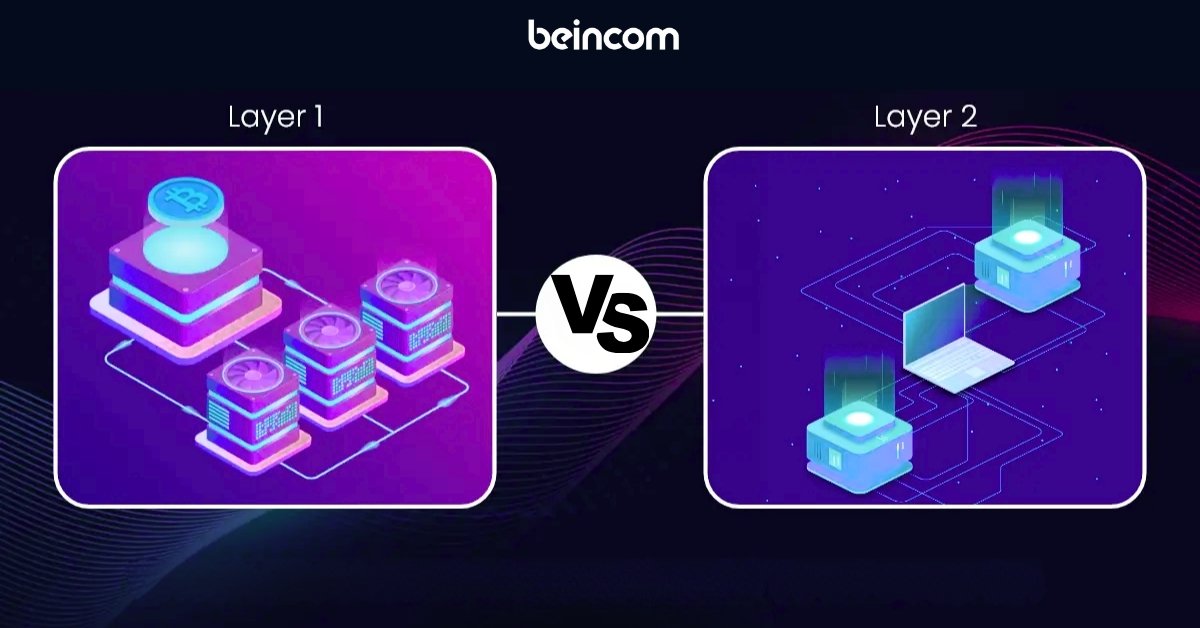
Layer 1 refers to the base blockchain architecture — the core network that validates and records transactions on a decentralized ledger. Think of it as the foundation of a building: everything else (including Layer 2) is built on top of it.
These networks are fully self-sufficient, meaning they have their own consensus mechanisms, native tokens, and security infrastructure. Transactions are settled directly on-chain, and any upgrades or changes to performance must be made at the protocol level.
Here are some well-known Layer 1s:
- Bitcoin (BTC) – The original blockchain, designed for secure peer-to-peer transactions.
- Ethereum (ETH) – The first programmable blockchain, enabling smart contracts and dApps.
- Solana (SOL) – Focused on high throughput and low fees using a hybrid consensus model.
- Avalanche (AVAX) – Offers multiple interoperable chains for flexibility and scalability.
- BNB Chain – Built for fast transactions and DeFi apps with low-cost execution.
Each Layer 1 blockchain has to balance the blockchain trilemma — scalability, security, and decentralization — and most make trade-offs. For instance, Bitcoin emphasizes security and decentralization but is relatively slow. Solana, on the other hand, opts for speed and throughput, sometimes at the cost of decentralization.
While Layer 1 networks form the core of crypto ecosystems, they often face limitations in terms of scalability — which is why Layer 2 solutions were developed.

What Is Layer 2?
Layer 2 solutions are protocols built on top of Layer 1 blockchains to improve scalability and reduce transaction costs — without compromising the security of the base chain. If Layer 1 is the highway, then Layer 2 is the express lane built above it to ease congestion.
Layer 2 network offloads much of the transactional workload from the main chain. Instead of processing every transaction directly on Layer 1, these systems bundle, compress, or defer transaction data — then submit the final results to the Layer 1 network for security and settlement.
Key goals of Layer 2 solutions:
- Faster transaction throughput
- Lower gas/fees
- Greater scalability for mass adoption
- Enhanced user experience
Here are some examples:
- Arbitrum & Optimism (Ethereum Rollups) – Bundle transactions off-chain and post proof to Ethereum, reducing congestion and cost.
- Polygon PoS – A sidechain that runs parallel to Ethereum, offering fast, low-fee transactions.
- zkSync & Starknet (ZK-Rollups) – Use zero-knowledge cryptography to achieve scalability with stronger security guarantees.
- Lightning Network (Bitcoin) – Enables near-instant BTC payments by settling only final balances on-chain.
These solutions inherit the security of their parent Layer 1 blockchain while dramatically improving efficiency and speed. That’s why Layer 2 is often considered crucial for mainstream adoption of crypto applications — especially in DeFi, gaming, and NFT ecosystems.

Discover how Layer 2 technology powers a faster, cheaper, and more decentralized SocialFi experience. Check out this article: Why Beincom Chose Arbitrum to Lead SocialFi Revolution
Layer 1 vs Layer 2: Key Differences
Understanding the distinction between Layer 1 and Layer 2 is essential for anyone navigating the blockchain ecosystem. While both are foundational to blockchain scalability and functionality, they serve different purposes and operate at different layers of the stack.
Here’s a breakdown of their core differences:
| Feature | Layer 1 | Layer 2 |
| Definition | The base blockchain protocol (e.g., Bitcoin, Ethereum) | A secondary framework built on top of Layer 1 |
| Function | Processes all transactions directly on-chain | Executes transactions off-chain or in batches, then settles on Layer 1 |
| Examples | Bitcoin, Ethereum, Solana, Avalanche | Arbitrum, Optimism, zkSync, Lightning Network |
| Scalability | Limited, requires protocol changes to improve | High, can handle thousands of transactions per second |
| Security | Secured by the base chain’s own consensus mechanism | Inherits security from Layer 1 but may add complexity |
| Transaction Speed | Often limited (e.g. 7–30 TPS) | Much higher (hundreds to thousands TPS) |
| Fees | Typically higher due to congestion and limited throughput | Significantly lower thanks to off-chain processing or rollups |
| Development Complexity | Simpler user experience but harder to scale | More complex infrastructure but enables fast, cheap transactions |
| Decentralization | Fully decentralized by design | Varies by implementation—some are more centralized than others |
| Use Cases | Settlement, value transfer, base logic | DeFi apps, games, microtransactions |
Think of Layer 1 like a highway, where every car (transaction) must pass through a single lane. It gets crowded fast. Layer 2 acts like express lanes or service roads that offload the main highway — giving users faster routes while still relying on the main road for final validation.
Pros and Cons of Layer 1 vs Layer 2
Now that we’ve broken down how Layer 1 and Layer 2 differ in theory and in practice, let’s zoom in on the real-world pros and cons of each. No blockchain solution is perfect — and both layers come with trade-offs depending on what you prioritize: speed, cost, security, or decentralization.
Here’s how they stack up:
Layer 1: Pros and Cons
Pros:
- Robust Security: All transactions are validated and finalized directly on-chain, making Layer 1s extremely secure and tamper-resistant.
- Decentralization by Design: With large validator or mining networks, these chains minimize central points of failure.
- Simplicity for Users: No extra layers or bridges needed — you interact directly with the base protocol.
Cons:
- Limited Scalability: Throughput is bottlenecked by the base layer’s consensus rules, often resulting in network congestion.
- Higher Costs: During busy periods, transaction fees (especially on Ethereum) can become prohibitively expensive.
- Slow Iteration: Any performance upgrade requires a protocol-level change, which takes time and coordination.
Layer 2: Pros and Cons
Pros:
- Faster Transactions: By executing activity off-chain or in batches, Layer 2s drastically reduce confirmation time.
- Cheaper Fees: Users save significantly on gas costs, especially for frequent or low-value transactions.
- Improved User Experience: Makes apps like gaming, social media, and real-time DeFi actually usable.
Cons:
- Added Complexity: Switching between L1 vs L2 blockchain (or across L2s) often involves bridges, wrapped tokens, or sync delays.
- Security Assumptions: While most L2s inherit security from the base chain, some still rely on centralized actors or unproven mechanisms.
- Ecosystem Fragmentation: Not all Layer 2s are equally integrated with existing tools, wallets, or liquidity pools.
Why Both Layers Matter for Blockchain’s Future
Blockchain Layer 1 vs Layer 2 aren’t competing — they’re complementary. Each plays a crucial role in pushing blockchain technology toward mass adoption.
Layer 1: The Foundation of Trust
Layer 1 networks are the trust anchors. They establish the security model, validate transactions, and serve as the base layer for everything else. Without a solid Layer 1, Layer 2s have no foundation to build upon. Think of them as the bedrock of the decentralized world — slow but sturdy.
Ethereum, Bitcoin, and Solana all continue to evolve their base protocols (e.g., Ethereum’s shift to Proof of Stake or Bitcoin’s Taproot upgrade) to support broader use cases while maintaining decentralization and security.
Layer 2: The Engines of Scale
Layer 2s are how blockchain becomes usable at scale. They handle the volume, the speed, and the cost-efficiency that modern applications require.
Solutions like Arbitrum or Optimism let users enjoy Ethereum’s security while paying a fraction of the gas fees and experiencing faster transactions. For Bitcoin, the Lightning Network enables near-instant payments — something unthinkable directly on-chain.
Together, They Make Web3 Possible
By layering solutions, the blockchain ecosystem benefits from the best of both worlds:
- Security and decentralization from Layer 1.
- Speed and affordability from Layer 2.
This dual approach is essential to support mainstream apps like decentralized finance (DeFi), NFT marketplaces, SocialFi platforms, Web3 ecosystem, and beyond.

Learn more: Web2 vs Web3: What Sets Them Apart?
The Future Is Multi-Layered
The blockchain space is no longer a battle between Layer 1 vs Layer 2 — it’s a collaboration. As the industry matures, it’s becoming clear that both layers are essential to meet the diverse needs of users, developers, and applications.
Ethereum’s roadmap itself reflects this: Layer 1 is being optimized for security and decentralization (via upgrades like danksharding and stateless clients), while Layer 2s are taking on the responsibility of handling day-to-day scalability.
We’re also seeing the rise of Layer 2-native apps — platforms built specifically to thrive in the faster, cheaper environment of rollups or sidechains. And as cross-chain bridges and interoperability protocols improve, the boundary between L1 and L2 blockchains will only blur further.
In the end, it’s not about choosing one over the other — it’s about building a layered ecosystem that’s scalable, secure, and usable for everyone.
Beincom is a next-gen SocialFi platform built on Arbitrum Layer 2. Fast, affordable, and decentralized — powered by the scalability of Layer 2.
- Create content and grow your community
- Own your data, earn $BIC tokens
- Mint NFTs, unlock gated spaces, and more
Experience what Layer 2 makes possible. Try Beincom today.
FAQs: Layer 1 vs Layer 2
Q1. What’s the difference between Layer 1 vs Layer 2?
Layer 1 is the base blockchain (e.g., Bitcoin, Ethereum) where transactions are processed directly on-chain. Layer 2 is built on top of Layer 1 to improve scalability and reduce fees, often by handling transactions off-chain and settling final results on the base layer.
Q2. Is Layer 2 as secure as Layer 1?
Layer 2 solutions inherit security from Layer 1, but the specific implementation (e.g., rollups, sidechains) can impact how secure or decentralized they are. Not all Layer 2s offer the same level of trust.
Q3. Can I move assets between Layer 1 and Layer 2?
Yes. You can bridge assets between L1 and L2 using blockchain bridges. This usually involves small fees and some waiting time, depending on the network.
Q4. Do I need a different wallet for Layer 2?
Not necessarily. Most wallets like MetaMask or Trust Wallet can interact with both Layer 1 and Layer 2 — you just need to add the appropriate network (like Arbitrum or Optimism) to your wallet.
Q5. Will Layer 2 replace Layer 1?
No. Layer 2 is designed to complement Layer 1, not replace it. It still relies on the underlying Layer 1 for final settlement and security. Together, they form a more scalable and user-friendly blockchain ecosystem.