The cryptocurrency market offers exciting investment opportunities, but it is also known for its high volatility. While some digital assets have delivered remarkable returns, concentrating your investments in a single coin or token can expose your portfolio to significant risk if market conditions suddenly change.
This is why crypto portfolio diversification is considered one of the most important principles of long-term investing. By spreading your investments across different types of cryptocurrencies, sectors, and blockchain ecosystems, you can reduce concentration risk while maintaining exposure to potential growth opportunities. In this guide, you’ll learn what crypto portfolio diversification is, why it matters, practical ways to build a balanced portfolio, and common mistakes to avoid.
What Is Crypto Portfolio Diversification?
Crypto portfolio diversification is the practice of spreading your investments across different cryptocurrencies and digital asset categories instead of putting all your capital into a single coin or token. The goal is to reduce overall investment risk while maintaining exposure to multiple growth opportunities within the crypto market.
Many beginners assume diversification simply means owning several cryptocurrencies. However, holding Bitcoin, Ethereum, Solana, and multiple Layer 1 tokens may not provide much protection if those assets all respond similarly to market conditions. A truly diversified crypto portfolio considers factors such as market capitalization, blockchain ecosystem, sector, and investment strategy rather than just the number of assets held.
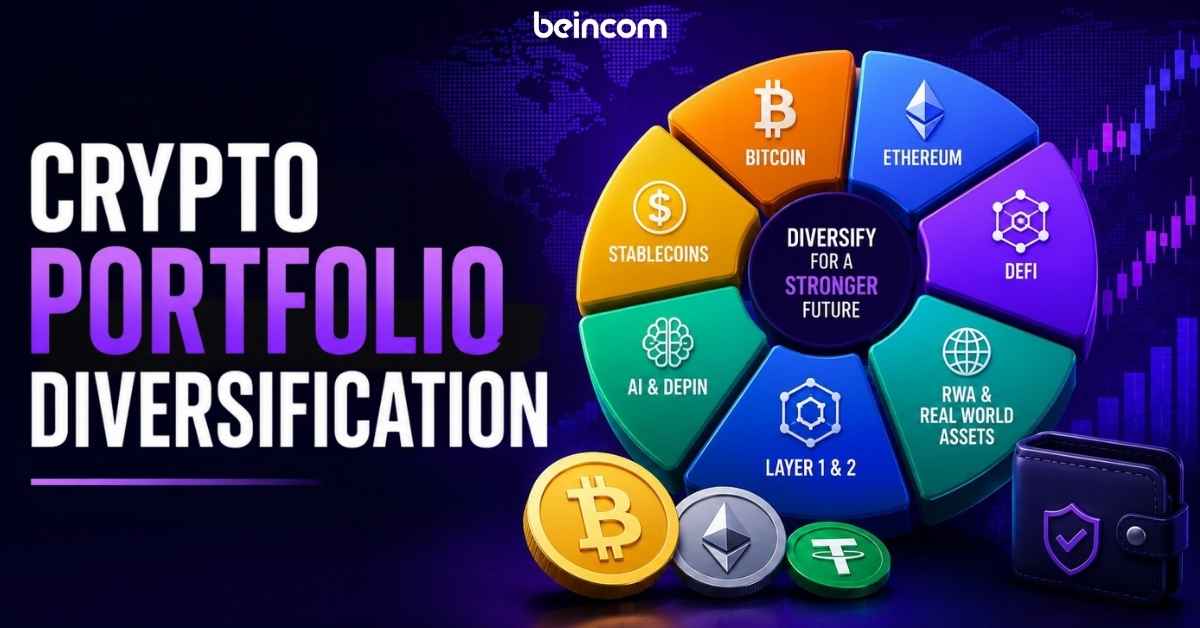
For example, a balanced portfolio might include:
- Large-cap cryptocurrencies like Bitcoin and Ethereum for long-term stability.
- Stablecoins to reduce volatility and provide liquidity.
- DeFi or Layer 2 tokens for exposure to decentralized finance and blockchain scaling.
- Emerging sectors such as AI, DePIN, or Real World Assets (RWA) for higher growth potential.
By allocating investments across different types of crypto assets, investors can avoid relying too heavily on the performance of a single project or market sector.
Diversification reduces concentration risk—it does not eliminate investment risk. Even a well-diversified crypto portfolio can lose value during broad market downturns, but diversification may help reduce the impact of poor performance from any one asset or sector.
Why Is Diversification Important in Crypto?
The cryptocurrency market is one of the most volatile asset classes in the world. Prices can rise dramatically during bull markets but also experience sharp declines within a short period. Because of this volatility, relying on a single cryptocurrency can expose investors to unnecessary risk.
A diversified crypto portfolio helps spread that risk across different assets and sectors. While diversification cannot prevent losses during a market-wide downturn, it can reduce the impact of poor performance from any individual investment.
Reduces Concentration Risk
Concentration risk occurs when too much of your portfolio depends on the performance of a single asset or sector.
For example, investing your entire portfolio in one altcoin means your returns depend entirely on that project’s success. If the project faces technical issues, regulatory challenges, or declining adoption, your portfolio could suffer significant losses.
Diversifying across multiple cryptocurrencies helps reduce this dependency and creates a more balanced investment strategy.
Helps Manage Market Volatility
Different crypto assets often react differently to changing market conditions.
For example, large-cap cryptocurrencies like Bitcoin and Ethereum may be relatively more resilient during market corrections than smaller altcoins. Stablecoins, meanwhile, can help preserve portfolio value during periods of high volatility by providing liquidity without requiring investors to exit the crypto market entirely.
By combining assets with different risk profiles, investors can better manage market fluctuations.
Provides Exposure to Multiple Growth Opportunities
The crypto industry is made up of many fast-growing sectors, each with its own use cases and growth potential.
These include:
- Layer 1 blockchains
- Decentralized Finance (DeFi)
- Artificial Intelligence (AI)
- Decentralized Physical Infrastructure Networks (DePIN)
- Real World Assets (RWA)
- Blockchain gaming
- Stablecoins
Rather than trying to predict which single sector will outperform, diversification allows investors to participate in several emerging trends simultaneously.
Encourages Long-Term Investing
Diversification can also promote better investment discipline.
Investors with diversified portfolios are often less likely to make emotional decisions based on the short-term performance of a single asset. Instead of constantly chasing the latest market trend, they can focus on maintaining a balanced portfolio that aligns with their long-term financial goals.
| Without Diversification | With Diversification |
|---|---|
| Portfolio depends heavily on one asset | Risk is spread across multiple assets |
| Higher exposure to sudden price swings | More balanced risk profile |
| Greater impact from a single project’s decline | Losses may be offset by stronger-performing assets |
| More emotional decision-making | Supports a more disciplined investment approach |
Different Ways to Diversify a Crypto Portfolio
There is no single “perfect” crypto portfolio. The right allocation depends on your investment goals, risk tolerance, and time horizon. However, a well-diversified portfolio usually spreads investments across multiple dimensions instead of focusing on just one type of asset.
Here are four practical ways to diversify your crypto portfolio.
Diversify by Market Capitalization
One of the simplest approaches is to invest in cryptocurrencies with different market capitalizations.
Generally, large-cap cryptocurrencies tend to be more established and less volatile than smaller projects, while mid-cap and small-cap assets may offer higher growth potential but carry greater risk.
| Market Cap | Characteristics | Examples |
|---|---|---|
| Large Cap | More established, higher liquidity, relatively lower risk | Bitcoin (BTC), Ethereum (ETH) |
| Mid Cap | Moderate risk with room for growth | Chainlink (LINK), Aptos (APT), Near Protocol (NEAR) |
| Small Cap | Higher growth potential but more volatile | Emerging blockchain and DeFi projects |
A balanced portfolio often combines assets from different market-cap categories rather than investing exclusively in smaller, high-risk tokens.
Diversify by Crypto Sector
The cryptocurrency industry consists of many sectors, each serving different purposes. Instead of investing only in one narrative, consider gaining exposure to multiple sectors.
| Sector | Purpose | Examples |
|---|---|---|
| Layer 1 | Blockchain infrastructure | Bitcoin, Ethereum, Solana |
| Layer 2 | Ethereum scaling solutions | Arbitrum, Optimism |
| DeFi | Decentralized financial services | Aave, Uniswap |
| Stablecoins | Price stability and liquidity | USDC, USDT |
| AI | AI-powered blockchain applications | Bittensor, Render |
| DePIN | Decentralized physical infrastructure | Helium, Filecoin |
| Real World Assets (RWA) | Tokenized real-world assets | Ondo Finance, Centrifuge |
Each sector responds differently to market trends. For example, DeFi protocols may perform well during periods of increased on-chain activity, while stablecoins can help reduce portfolio volatility during uncertain market conditions.
Diversify Across Blockchain Ecosystems
Many investors unintentionally concentrate their holdings within a single blockchain ecosystem.
For example, owning several Ethereum-based tokens still exposes your portfolio to risks affecting the Ethereum network, such as high gas fees or ecosystem-wide downturns.
Instead, consider spreading investments across multiple blockchain ecosystems, such as:
- Ethereum
- Solana
- BNB Chain
- Avalanche
- Base
- Sui
This approach provides exposure to different developer communities, applications, and technological innovations.
Diversify by Investment Strategy
Diversification isn’t only about what you own—it’s also about how you invest.
Rather than relying on a single strategy, many investors combine several approaches to balance growth, income, and risk.
Examples include:
- Long-term investing (HODLing): Holding fundamentally strong assets over multiple market cycles.
- Dollar-Cost Averaging (DCA): Investing a fixed amount regularly to reduce the impact of market volatility.
- Staking: Earning rewards by helping secure proof-of-stake blockchain networks.
- Yield Farming: Providing liquidity or participating in DeFi protocols to generate additional returns.
Using multiple investment strategies can create a more resilient portfolio while reducing the temptation to chase short-term market trends.