
In a market known for volatility, stablecoins stand out as the calm center of the crypto storm. While Bitcoin and Ethereum prices can rise or fall by double digits in a single day, stablecoins are designed to do the opposite — maintain a steady value, typically pegged to a traditional currency like the U.S. dollar.
Over the past few years, stablecoins have become a cornerstone of the digital economy. They enable faster payments, easier trading, and greater accessibility to decentralized finance (DeFi). Whether you’re sending money across borders, hedging against volatility, or exploring DeFi platforms, stablecoins offer the stability and flexibility that most cryptocurrencies lack.
Let’s break down what stablecoins are, how they work, the different types available, and their growing importance in connecting traditional finance (TradFi) with Web3.
What Are Stablecoins?
Stablecoins are a type of cryptocurrency designed to maintain a stable value, usually pegged to a real-world asset like the U.S. dollar, the euro, or even gold. Unlike volatile digital assets such as Bitcoin or Ethereum, stablecoins aim to keep their price consistent — typically around 1 USD per token — by being backed or algorithmically controlled.
At their core, stablecoins bridge the gap between traditional finance and crypto. They allow investors to hold and transfer value on the blockchain without being exposed to the sharp price swings of other cryptocurrencies.
For example:
- USDT (Tether) and USDC (USD Coin) are pegged 1:1 to the U.S. dollar.
- DAI, a decentralized stablecoin, maintains its peg through smart contracts and crypto collateral.
This stability makes stablecoins ideal for everyday transactions, remittances, and decentralized finance (DeFi) applications — where predictability and liquidity are essential.

How Do Stablecoins Work?
The key to stablecoins lies in their ability to maintain a fixed value — usually pegged 1:1 to a fiat currency like the U.S. dollar. To achieve this, different projects use various mechanisms and reserve structures.
The Peg Mechanism
Most stablecoins are “pegged” to an external asset, meaning their value mirrors that of something stable — like USD or gold. For instance, 1 USDT or 1 USDC is always intended to equal 1 USD. The method of maintaining this peg depends on how the stablecoin is backed.
Backing Models
Fiat-Collateralized Stablecoins
These are backed by reserves of traditional currency held by a central entity. For example, Tether (USDT) and USD Coin (USDC) claim to hold cash, bonds, or equivalent assets equal to the number of tokens in circulation. When users buy stablecoins, the issuer adds equivalent funds to its reserves; when they redeem them, those funds are withdrawn.
Crypto-Collateralized Stablecoins
These are backed by other cryptocurrencies instead of fiat. To manage volatility, they are over-collateralized — meaning users must deposit more crypto value than the stablecoins they mint. For example, DAI from MakerDAO is backed by assets like ETH or USDC locked in smart contracts.
Algorithmic Stablecoins
These maintain price stability through algorithms and supply-demand mechanisms instead of collateral. When the price goes above $1, new tokens are minted; when it falls below $1, tokens are burned. While innovative, algorithmic stablecoins — like UST (Terra) — have shown vulnerability to market shocks.
Price Stability and Redemption
In most stablecoins, stability is maintained by arbitrage. If a stablecoin trades below $1, traders buy and redeem it for the underlying asset, pushing the price back up. If it rises above $1, they sell, restoring the peg.
In short, stablecoins work by combining collateral, algorithms, and market incentives to keep their price steady — offering reliability in a volatile crypto environment.
Use Cases of Stablecoins
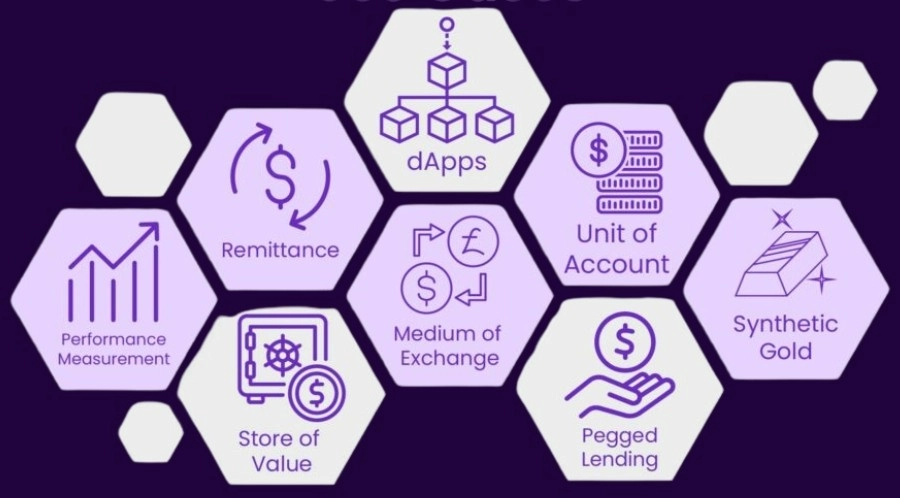
Stablecoins have become one of the most versatile tools in the cryptocurrency market — offering stability, liquidity, and accessibility that few other digital assets can match. Their use cases now extend far beyond trading, playing a major role in payments, finance, and blockchain innovation.
Trading and Market Stability
They serve as the primary medium of exchange in crypto trading. Since they maintain a stable value, traders use them to move funds between exchanges or hedge against market volatility without cashing out into fiat currencies. Pairs like BTC/USDT or ETH/USDC dominate trading volumes across most major exchanges.
Cross-Border Payments and Remittances
Because stablecoin operates on blockchains, it enables instant global transactions with low fees — no intermediaries, no delays. For individuals or businesses sending money internationally, it is faster and cheaper than bank wires or traditional remittance services.
Decentralized Finance (DeFi)
They are the foundation of DeFi protocols, powering lending, borrowing, and yield farming. Platforms like Aave, Curve, and MakerDAO rely heavily on stablecoins for liquidity and as a benchmark of value. In DeFi, users can earn passive income by providing stablecoin liquidity or staking stablecoin in yield pools.
Access to Financial Services for the Unbanked
In regions where traditional banking is limited or unstable, stablecoin provides a digital alternative to cash. Anyone with a smartphone and internet connection can store, send, and receive stablecoins without a bank account — promoting financial inclusion worldwide.
Store of Value and Medium of Exchange
Stablecoin acts as a safe haven during volatile market periods. Investors often convert their crypto holdings into stablecoins to protect their portfolios from sudden losses while staying within the blockchain ecosystem.
In short, stablecoins are not just a bridge between fiat and crypto — they’re becoming the backbone of digital payments, decentralized finance, and the global Web3 economy.
Types of Stablecoins
While all stablecoins share the same goal — maintaining price stability — they achieve it through very different mechanisms. Understanding how each type works is essential to assessing its reliability, transparency, and risk level.

Fiat-Backed Stablecoins
Fiat-backed stablecoins are the most widely used and easiest to understand. Each token is backed by a traditional currency like the U.S. dollar, euro, or yen, held in reserves by a centralized company or bank. For every stablecoin issued, there’s an equivalent amount of fiat currency or short-term liquid assets (like U.S. Treasuries) held in custody.
These stablecoins maintain their peg through direct redemption — users can exchange tokens for fiat at a 1:1 ratio. Because of their stability and simplicity, they’re heavily used in crypto trading, payments, and remittances. However, they require trust in the issuer’s reserve management and regular audits to ensure full backing.
Examples:
- USDT (Tether) – The oldest and most traded stablecoin, pegged 1:1 to USD.
- USDC (USD Coin) – Issued by Circle, known for high transparency and regular attestations.
- BUSD (Binance USD) – Previously regulated under U.S. oversight before being phased out in 2024.
Crypto-Backed Stablecoins
Crypto-backed stablecoins are backed by other cryptocurrencies instead of fiat. They use smart contracts to lock collateral and maintain transparency. Because crypto assets are volatile, these stablecoins are typically over-collateralized — meaning users must deposit more value than they borrow in stablecoins (e.g., $150 in ETH to mint $100 of DAI).
When the value of collateral drops too much, the system automatically liquidates it to protect the peg. This model is decentralized, transparent, and censorship-resistant, but it’s also vulnerable during sharp market crashes when collateral values fall rapidly.
Examples:
- DAI (MakerDAO) – Pegged to USD and backed by multiple crypto assets like ETH and USDC.
- sUSD (Synthetix USD) – Backed by SNX tokens and used across the Synthetix ecosystem.
- LUSD (Liquity USD) – Backed solely by ETH, maintaining full decentralization.
Commodity-Backed Stablecoins
Commodity-backed stablecoins derive their value from real-world physical assets, such as gold, silver, or oil. Each token represents ownership of a specific quantity of the commodity stored by a custodian. This gives them intrinsic value and makes them attractive to investors seeking inflation protection or diversification.
However, their use is more niche due to limited scalability — physical assets must be stored, insured, and verified — and liquidity is often lower than fiat-backed stablecoins.
Examples:
- PAX Gold (PAXG) – Each token represents one troy ounce of gold held in London vaults.
- Tether Gold (XAUT) – Backed by allocated gold reserves managed by Tether.
Algorithmic Stablecoins
Algorithmic stablecoins maintain their peg not with collateral, but through automated supply-and-demand adjustments. Smart contracts increase or decrease the supply of tokens depending on market price. When the token price rises above $1, new tokens are minted; when it falls below $1, the supply contracts (tokens are burned).
While this approach aims for decentralization and efficiency, it’s also the most fragile. Without strong demand and confidence, algorithmic systems can collapse quickly — as seen in the 2022 TerraUSD (UST) crash, which wiped out billions in market value.
Examples:
- FRAX – A partially algorithmic, partially collateralized stablecoin.
- AMPL (Ampleforth) – Adjusts supply daily based on market price.
- UST (TerraUSD) – A failed algorithmic stablecoin that lost its peg in 2022.
Benefits and Risks of Stablecoins
Stablecoins play a critical role in making the crypto market more practical and accessible. Their design offers many advantages over traditional financial systems and volatile cryptocurrencies — but they also introduce new kinds of risk tied to trust, regulation, and technology.
Benefits of Stablecoins
- Price Stability: Stablecoins provide a consistent value, making them ideal for trading, payments, and everyday use. They protect users from the extreme volatility of cryptocurrencies like Bitcoin or Ethereum.
- Global Accessibility: Anyone with an internet connection can send or receive stablecoins instantly, bypassing traditional banking systems and high remittance fees. This promotes financial inclusion in regions where banking infrastructure is limited.
- Efficiency and Low Fees: Stablecoin transactions are fast and inexpensive compared to cross-border wire transfers or credit card payments. On blockchains like Tron or Solana, fees can be just a few cents per transaction.
- DeFi Integration: Stablecoins serve as the backbone of Decentralized Finance (DeFi) — powering lending, staking, yield farming, and liquidity pools. They’re the preferred asset for earning yields while minimizing exposure to price swings.
- Transparency and Programmability: Most stablecoins operate on public blockchains, allowing users to verify transactions and reserves. Smart contracts make them programmable, enabling automation of payments, collateralization, and DeFi operations.
Risks of Stablecoins
- Centralization and Counterparty Risk: Fiat-backed stablecoins rely on centralized entities to manage reserves. If issuers mismanage funds or face regulatory crackdowns, users may lose trust — or access — to their holdings.
- Depegging Events: When stablecoins fail to maintain their 1:1 peg (like TerraUSD in 2022), confidence collapses quickly. Even small deviations can trigger panic selling and liquidity crises.
- Regulatory Uncertainty: Governments worldwide are still developing rules for stablecoins. Stricter oversight could affect issuance, redemption, or even availability on exchanges.
- Smart Contract Vulnerabilities: Crypto- and algorithmic-backed stablecoins depend on complex code. Bugs, exploits, or oracle failures could cause collateral losses or peg instability.
- Market Concentration: A handful of stablecoins — mainly USDT and USDC — dominate global volume. This concentration raises systemic risks if one of them faces technical or legal trouble.
- Stablecoins bring together the best of both worlds — the speed of crypto and the stability of fiat — but users must understand that no system is completely risk-free. The key is to balance utility with due diligence when choosing which one to use.
The Role of Stablecoins in DeFi and Crypto Adoption
Stablecoins have evolved far beyond being just a “safe haven” for traders — they’re now the financial backbone of the Web3 economy. By providing a stable, on-chain form of money, they enable liquidity, accessibility, and innovation across DeFi, remittances, and digital commerce.
Foundation of DeFi Liquidity
DeFi protocols like Aave, Compound, and Curve rely heavily on stablecoins to power lending, borrowing, and trading activities. Because their value remains stable, stablecoins act as the base currency for most decentralized markets.
- Users deposit stablecoins to earn interest or liquidity rewards.
- Borrowers use them as predictable, low-volatility assets.
- Protocols use them to measure returns and collateral ratios consistently.
Without stablecoins, DeFi markets would struggle to function — as they provide the liquidity anchor needed for long-term sustainability.
Bridging Traditional Finance and Web3
Stablecoins serve as the bridge between fiat and crypto, allowing users to move funds easily across ecosystems. Investors can trade stablecoins like USDC or USDT on centralized exchanges, then transfer them to Web3 wallets or DeFi platforms in seconds.
This ease of conversion has made stablecoins the preferred entry point for newcomers to crypto — and a key driver of global crypto adoption.
Real-World Utility and Payments
Beyond trading, stablecoins are now used for real-world payments and business transactions. Merchants, freelancers, and remote workers increasingly accept stablecoins as fast, borderless payments that don’t require traditional banking infrastructure.
For example, companies like Circle (USDC) and Tether (USDT) are collaborating with fintech firms to expand stablecoin payment networks worldwide.
Supporting Emerging Economies
In countries with high inflation or unstable currencies, stablecoin provides a digital alternative to the U.S. dollar, helping people preserve value and access global markets. In regions like Latin America, Africa, and Southeast Asia, adoption has surged as users turn to stablecoins for daily financial use.
Driving Crypto Innovation
Stablecoin has become the building block for new financial products — from algorithmic protocols and synthetic assets to blockchain-based credit systems. They play a pivotal role in shaping tokenized economies, where assets, identities, and contracts coexist on-chain.
In essence, stablecoins are no longer just tools for traders — they’re the connective tissue between Web2 and Web3, enabling a more open, inclusive, and borderless financial system.
Learn more: How to Invest in DeFi: A Full Guide for Beginners
Conclusion
Stablecoins have become an indispensable part of the digital economy, bridging the gap between volatile cryptocurrencies and the stability of traditional finance. They make crypto trading smoother, enable cross-border payments, and power much of the activity in DeFi — all while offering users a familiar, dollar-like experience on-chain.
Yet, their growing influence also brings greater responsibility. Whether centralized or algorithmic, every stablecoin depends on transparency, regulation, and user trust. As adoption expands and governments work toward clearer policies, they are likely to become the foundation of mainstream crypto finance — not just a trading tool, but the digital cash of the Web3 era.
FAQs
Q1. What is a stablecoin in simple terms?
A stablecoin is a cryptocurrency designed to maintain a stable value — usually pegged to a traditional currency like the U.S. dollar. It combines the speed and transparency of crypto with the stability of fiat money.
Q2. How do stablecoins stay at $1?
Stablecoins maintain their peg through collateral or algorithmic mechanisms. Fiat-backed ones hold reserves equal to their circulation, while crypto-backed and algorithmic ones rely on smart contracts and supply adjustments to stabilize price.
Q3. Are stablecoins safe?
They’re generally safer than volatile cryptocurrencies, but not risk-free. Fiat-backed stablecoins depend on the issuer’s transparency and regulation, while algorithmic ones can fail if market confidence collapses. Always research a stablecoin’s reserves and audits before using it.
Q4. What are the most popular stablecoins?
The most widely used stablecoins are USDT (Tether), USDC (USD Coin), and DAI (MakerDAO). Together, they account for the majority of global stablecoin transaction volume.
Q5. How are stablecoins used in DeFi?
In DeFi, stablecoins serve as the base asset for lending, borrowing, staking, and liquidity pools. They allow users to earn yield or manage risk without leaving the crypto ecosystem.
Q6. Can stablecoin replace traditional money?
Not yet — but they’re getting closer. Stablecoins are faster, cheaper, and more borderless than fiat, and governments worldwide are exploring Central Bank Digital Currencies (CBDCs) inspired by them.