In the world of Decentralized Finance (DeFi), users can earn passive income by providing liquidity to decentralized exchanges (DEXs). While this seems like a straightforward way to make returns, there’s a hidden risk that often surprises new investors — impermanent loss.
Impermanent loss happens when the price of the tokens you’ve deposited into a liquidity pool changes compared to when you first deposited them. Even if the pool generates trading fees, the value of your assets might still end up lower than if you had just held them. Understanding how impermanent loss works is essential for anyone joining the DeFi ecosystem, as it directly affects your potential profit or loss when providing liquidity.
What Is Impermanent Loss?
Impermanent loss occurs when the price ratio of tokens in a liquidity pool changes compared to when they were first deposited. Liquidity providers (LPs) earn trading fees from swaps happening in the pool, but the value of their deposited tokens can diverge from simply holding them.
Let’s break it down with an example:
Suppose you deposit 1 ETH and 1,000 USDC into a liquidity pool when 1 ETH = 1,000 USDC. Later, if ETH’s price doubles to 2,000 USDC, traders will buy ETH from the pool until the ratio between ETH and USDC reflects the new market price. As a result, you’ll end up with less ETH and more USDC when you withdraw your liquidity.
Even though you still earn a portion of trading fees, the total value of your withdrawn assets might be lower than if you had simply held onto your ETH and USDC — that’s impermanent loss. The loss becomes “permanent” only when you remove your funds from the pool while the prices are still different.
In short, impermanent loss represents the opportunity cost of providing liquidity in volatile markets — it’s “impermanent” because if the prices return to their original ratio, the loss disappears. But since crypto markets rarely remain stable, managing this risk is key for DeFi participants.
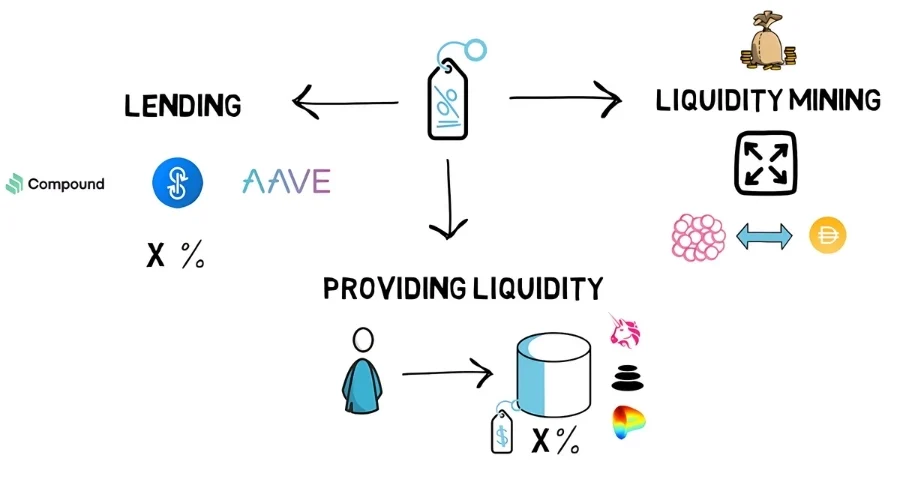
How Impermanent Loss Happens (and Why It Matters)
Impermanent loss occurs when the value of your deposited tokens changes compared to when you added them to a liquidity pool. This is an inherent risk of decentralized exchanges (DEXs) built on Automated Market Makers (AMMs) like Uniswap, PancakeSwap, or Balancer. To understand why it happens, let’s break it down into 3 key factors:
Crypto Market Volatility
Volatility is the biggest driver of impermanent loss. When one token in a liquidity pair — say ETH in an ETH/USDC pool — increases in price, traders will buy ETH from the pool to arbitrage the price difference with external markets. This activity reduces the ETH balance in the pool and increases the USDC side.
As a result, when prices shift significantly, liquidity providers (LPs) end up with more of the token that lost value and less of the one that gained. The greater the volatility between the two tokens, the higher the impermanent loss. Stablecoin pairs (like USDC/DAI) experience minimal loss because their prices remain closely pegged.
AMM Pricing Algorithms
AMMs operate using mathematical formulas like the constant product formula (x × y = k), which ensures that the product of the two token reserves remains constant. When a trader swaps tokens, the AMM automatically adjusts the pool’s ratio to reflect the new prices.
While this mechanism enables decentralized trading without order books, it also exposes LPs to loss whenever prices diverge. The algorithm ensures liquidity, but at the cost of forcing LPs to hold more of the underperforming asset — creating impermanent loss compared to simply holding both tokens outside the pool.
LP Token Redemption
When liquidity providers withdraw their funds, they receive a share of both tokens based on the current ratio in the pool. If token prices have changed since the initial deposit, the value of their share may be lower than if they had just held the tokens.
This is when impermanent loss becomes realized — if prices haven’t returned to their original levels, the LP has effectively locked in the loss. However, this loss can sometimes be offset by trading fees and reward incentives (such as yield farming), depending on the pool’s activity and design.
In short, impermanent loss is the price of providing liquidity in volatile markets. It’s not always bad — in active pools with high trading volumes and fees, LPs can still end up profitable. But understanding how these factors work together is crucial to managing risk effectively in DeFi.

Learn more: Crypto Staking Explained: How It Works, Types & Benefits
How to Calculate Impermanent Loss
Impermanent loss can be tricky to visualize at first, but the math behind it is fairly straightforward. It measures the difference between the value of your assets if you held them versus the value of your assets after providing liquidity to a pool.
The general formula for impermanent loss (IL) is:
IL = 2 × √P / (1 + P) - 1*Where P represents the price ratio between the two assets after the price changes.
Let’s break this down with an example:
Suppose you deposit 1 ETH (worth $1,000) and 1,000 USDC into a liquidity pool when ETH is $1,000. The total deposit value is $2,000.
- Later, ETH doubles to $2,000.
- The AMM rebalances the pool to maintain its constant product (x × y = k).
- You’ll end up holding 0.707 ETH and 1,414 USDC, worth about $2,828.
- If you had simply held your assets, they would now be worth $3,000 (1 ETH = $2,000 + 1,000 USDC).
The impermanent loss here is $172, or about 5.7%, compared to holding.
While this may seem small, the loss becomes more significant with larger price movements — and less noticeable when prices are stable.
In real-world DeFi, most liquidity providers use online impermanent loss calculators to estimate risk before depositing assets. It’s a simple but essential step to ensure your expected trading fee rewards outweigh the potential losses from volatility.
How to Reduce or Avoid Impermanent Loss
While impermanent loss is an inherent risk in providing liquidity to automated market makers (AMMs), there are several strategies you can use to minimize or even offset its effects. Here are the most effective methods:
Choose Stablecoin Pairs
One of the simplest ways to reduce impermanent loss is to provide liquidity to stablecoin-to-stablecoin pools, such as USDC/USDT or DAI/USDC.
- Because these assets are pegged to the same value (usually $1), price fluctuations are minimal.
- This dramatically reduces volatility — and therefore the potential for impermanent loss.
- However, the tradeoff is typically lower trading fees and lower yield potential compared to riskier pools.
Opt for Low-Volatility Token Pairs
If you prefer non-stablecoin pairs, consider assets that move in similar price directions.
- For example, ETH/wstETH, BTC/wBTC, or LSD pairs like stETH/rETH often experience correlated price changes.
- This correlation reduces the amount of rebalancing the AMM must do, minimizing impermanent loss.
Use Protocols Offering Impermanent Loss Protection
Some DeFi protocols now offer built-in protection or compensation mechanisms for LPs.
- Platforms like Bancor and Thorchain have introduced features that reimburse liquidity providers for losses incurred over time.
- These protections may come with lockup periods or reduced yield, but they can provide peace of mind for newer investors.
Consider Single-Sided Liquidity Options
Certain AMMs allow you to deposit just one asset instead of two.
- This eliminates price exposure on the other side of the pair.
- Examples include Balancer, Bancor, and Tokemak, which offer single-sided or asymmetric liquidity options.
Balance Reward Potential Against Risk
Ultimately, managing impermanent loss is about understanding the tradeoff between yield and price exposure.
- Always compare the expected trading fee revenue and token incentives to the potential impermanent loss from volatility.
- In many cases, the returns from fees and rewards can outweigh the impermanent loss if managed carefully.
By combining these strategies, liquidity providers can actively manage risk and make more informed decisions in DeFi.
Read more: How to Stay Safe in DeFi: Simple Ways to Protect Your Crypto
Impermanent Loss Example
Here’s a concrete example to illustrate how impermanent loss works in practice:
Suppose a user provides liquidity to an ETH/USDC pool. They deposit 2 ETH (worth $1,500 each) and 3,000 USDC, totaling $6,000 in assets. The pool already holds 40 ETH and 60,000 USDC, so the user’s contribution is 5% of the total pool value.
Over time, ETH price doubles from $1,500 to $3,000. Traders notice the price difference and arbitrage by adding USDC to the pool and removing ETH, causing the pool to rebalance. After rebalancing, the pool holds 28.28 ETH and 84,852.81 USDC.
If the user withdraws their share at this point:
- Their assets are 1.414 ETH + 2,121.57 USDC, totaling about $5,707.
- If they had simply held the original 2 ETH + 3,000 USDC, the value would be $6,000.
This means the user experiences an impermanent loss of 5.72%, though they may have earned some trading fees that partially offset this loss.
It’s called “impermanent” because if they leave their funds in the pool and prices return to the original ratio, the loss could decrease or disappear.
The Bottom Line: Why Impermanent Loss Matters for Every DeFi Investor
Impermanent loss is one of the most important concepts for anyone providing liquidity in DeFi to understand. While it doesn’t always result in a permanent loss, failing to account for it can significantly reduce your potential profits — especially in volatile markets.
By knowing how impermanent loss occurs, how to calculate it, and strategies to mitigate it, liquidity providers can make informed decisions about which pools to join and how much risk to take. Pairing this knowledge with careful selection of token pairs, monitoring market conditions, and leveraging fee and reward incentives can make liquidity provision a profitable and sustainable strategy.
In essence, impermanent loss isn’t something to fear — it’s a manageable risk. Understanding it gives you the tools to maximize returns while protecting your capital in the fast-paced world of DeFi.
FAQs
Q1. What is impermanent loss in DeFi?
Impermanent loss is the temporary reduction in value that occurs when you provide liquidity to a pool and the price of your deposited tokens changes compared to simply holding them in your wallet. It becomes permanent only when you withdraw your funds at unfavorable prices.
Q2. How does impermanent loss differ from regular loss?
Unlike a traditional loss, impermanent loss can fluctuate. If token prices return to their original ratio, the loss may decrease or even disappear. Regular losses, like selling an asset at a lower price than purchase, are permanent.
Q3. Can impermanent loss be avoided completely?
No, it cannot be fully avoided if you provide liquidity in volatile pools. However, strategies like choosing stablecoin pairs, low-volatility token pairs, diversification, and leveraging pool incentives can minimize the impact.
Q4. Does impermanent loss make liquidity provision unprofitable?
Not necessarily. Trading fees and protocol rewards can often offset impermanent loss, especially in high-volume pools. Careful selection of pools and monitoring can make liquidity provision profitable over time.
Q5. Are there tools to calculate impermanent loss?
Yes, many DeFi platforms and online calculators allow you to estimate impermanent loss based on your token pair, pool share, and price changes. This helps LPs make informed decisions before depositing.
Q6. Why is understanding impermanent loss important?
Understanding impermanent loss helps you assess the risk of providing liquidity, plan strategies to mitigate losses, and determine whether the rewards from a pool are worth the potential exposure.