Blockchain networks rely on consensus mechanisms to validate transactions and secure their ledgers. These mechanisms determine how new blocks are added, how participants reach agreement, and how the network stays secure without a central authority. Among dozens of models developed over the years, Proof of Work vs Proof of Stake have emerged as the 2 dominant approaches in both theory and real-world adoption.
Proof of Work (PoW) is the original consensus mechanism used by Bitcoin, relying on computational competition to secure the network. Proof of Stake (PoS), in contrast, selects validators based on the amount of cryptocurrency they lock up as collateral. Both aim to achieve the same goal—secure, decentralized transaction validation—but they do so in fundamentally different ways.
Understanding these differences is essential for anyone investing, building, or simply trying to navigate the crypto ecosystem. Let’s dive in!
What Is Proof of Work (PoW)?
Proof of Work is the first and most established blockchain consensus mechanism, introduced by Bitcoin in 2009. In PoW networks, miners compete to solve complex cryptographic puzzles. The first miner to solve the puzzle earns the right to add the next block to the blockchain, receiving a block reward and transaction fees in return.
This process requires significant computing power and electricity, which acts as a security feature. Because attacking the network would require controlling over 50% of the total mining power, PoW makes manipulation extremely expensive and practically impossible for most attackers.
PoW is considered highly secure and decentralized due to its reliance on open participation and physical resource expenditure. However, its energy consumption and slower block times have led to debates and the rise of alternative models like Proof of Stake.
Pros:
- Battle-tested security: PoW has been proven secure for over 15 years through Bitcoin and other major chains.
- Harder to attack: An attacker must control 51% of total mining power, which requires massive physical infrastructure.
- Fully decentralized mining (in theory): Anyone with hardware can participate.
Cons:
- High energy consumption: Mining requires enormous electricity, raising environmental concerns.
- Expensive entry cost: ASICs and GPU rigs are costly, making mining less accessible.
- Slow transaction throughput: PoW networks often handle fewer transactions per second due to hardware limitations.
- Mining centralization risk: Industrial mining farms dominate hash power in many networks.

What Is Proof of Stake (PoS)?
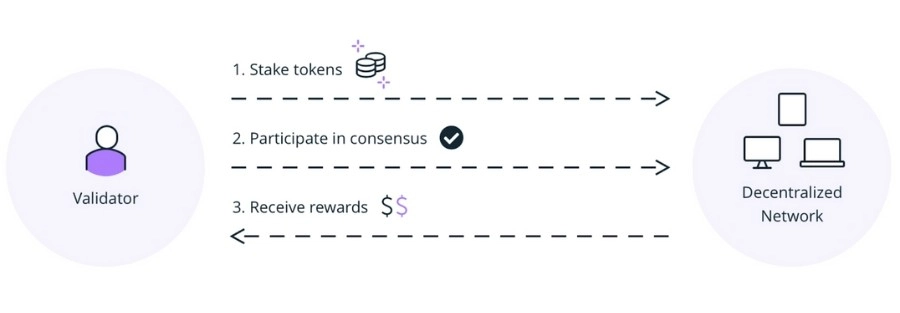
Proof of Stake is a newer consensus mechanism designed as a more energy-efficient alternative to Proof of Work. Instead of relying on computational power, PoS selects validators based on the amount of cryptocurrency they “stake” (lock) on the network.
Validators are randomly chosen to propose and confirm new blocks. The more tokens they stake, the higher their chances of being selected — aligning economic incentives with network security. If a validator behaves maliciously, part or all of their stake can be slashed, discouraging attacks.
PoS significantly reduces energy consumption, allows for faster transaction speeds, and generally makes blockchain participation more accessible, as users don’t need expensive mining hardware. Many modern blockchains — including Ethereum after The Merge — are transitioning to or starting with PoS because of its scalability and sustainability advantages.
Pros:
- Energy-efficient: No specialized hardware required — staking consumes over 99% less energy than PoW.
- Lower barrier to entry: Anyone can stake tokens, either directly or through a staking service.
- Scalable performance: PoS chains like Solana, Avalanche, and Polygon can support far more transactions per second than PoW networks.
- Economic security model: Attacks cost real money — malicious validators can have their stake slashed.
Cons:
- Wealth concentration risk: The more tokens you own, the more rewards you receive — potentially reinforcing inequality.
- Centralization concerns: Many users stake through centralized exchanges, increasing reliance on intermediaries.
- Less proven than PoW: PoS is newer and has not been stress-tested at Bitcoin scale for over a decade.
- Complex slashing mechanisms: Stakers can lose funds due to misbehavior or even technical mistakes.
Proof of Work vs Proof of Stake: Key Differences
| Category | Proof of Work (PoW) | Proof of Stake (PoS) |
| How it works | Miners solve cryptographic puzzles to validate blocks | Validators are chosen based on the amount of tokens staked |
| Security model | Secured by computational power (hashrate) | Secured by economic stake — malicious actors lose funds |
| Energy consumption | Extremely high (requires mining hardware & electricity) | Very low (no specialized hardware required) |
| Hardware requirements | ASICs, GPUs, mining rigs | Standard computers or even staking services |
| Entry barrier | High cost to mine profitably | Lower — anyone can stake tokens |
| Scalability | Limited — slower TPS due to physical mining constraints | More scalable — faster finality and block times |
| Economic incentives | Block rewards + transaction fee | Staking rewards + transaction fees |
| Risk of centralization | Mining farms can dominate the network | Large token holders may control staking power |
| Examples | Bitcoin, Litecoin, Dogecoin | Ethereum, Solana, Cardano, Avalanche |
In short:
- PoW prioritizes hardware-based security but consumes massive energy.
- PoS prioritizes capital-based security, improves efficiency, but may concentrate power among wealthy token holders.
Real-World Examples & Use Cases
Understanding Proof of Work (PoW) and Proof of Stake (PoS) is easier when we look at real-world examples. Each mechanism is used by major blockchain networks and has influenced how developers design decentralized applications.
Bitcoin (PoW)
Bitcoin, launched in 2009, is the most well-known example of a PoW blockchain. It relies on miners solving cryptographic puzzles to validate transactions and secure the network.
Key Points:
- Security: Extremely high due to the massive global hash power.
- Decentralization: Anyone with mining hardware can participate.
- Use case: Primarily a store of value and digital gold.
- Trade-off: High energy consumption and slower transaction speed compared to PoS networks.
Bitcoin demonstrates how PoW can secure a blockchain over more than a decade without central authority.
Ethereum’s Transition from PoW to PoS (The Merge)
Ethereum initially used PoW but transitioned to PoS with The Merge in 2022. This shift significantly reduced energy consumption by over 99% and enabled faster, cheaper transactions.
Key Points:
- Staking rewards: Users can participate by staking ETH instead of running mining hardware.
- Use case: Supports smart contracts, DeFi, NFTs, and Web3 applications at scale.
- Security model: PoS ensures economic incentives align with network integrity, while slashing penalizes malicious validators.
Ethereum illustrates how a major blockchain can evolve from PoW to PoS to improve sustainability and scalability.
Read more: Top Ethereum Layer 2 Projects: Faster, Cheaper & Smarter
Hybrid or Other Models
Some blockchains adopt hybrid consensus mechanisms, combining PoW and PoS or integrating advanced cryptographic techniques such as Proof of Authority (PoA) or Delegated Proof of Stake (DPoS).
Examples:
- Decred: PoW + PoS hybrid to balance mining security and stakeholder governance.
- EOS & Tron: DPoS for high-speed transactions with elected validators.
Hybrid systems aim to combine security, decentralization, and efficiency for specific network goals.
Which Mechanism Is Better — And When?
The choice between Proof of Work vs Proof of Stake depends on the specific use case, priorities, and network goals. Neither mechanism is universally “better”—each excels in different scenarios.
Use-Case-Based Comparison:
PoW is preferred when:
- Security and immutability are top priorities (e.g., Bitcoin).
- The network is primarily a store-of-value or asset transfer layer.
- Energy consumption is less of a concern for network participants.
PoS is preferred when:
- High transaction throughput and low fees are needed (e.g., Ethereum post-Merge, Solana).
- Energy efficiency and sustainability are important.
- Broader participation from token holders is desired for network governance and validation.
Key Takeaway: PoW is ideal for maximum security and decentralization, whereas PoS is ideal for scalability, accessibility, and eco-friendliness. Many modern blockchains evaluate their needs and may even adopt hybrid or adaptive models to balance trade-offs.
Future Trends and Evolving Consensus Models
Blockchain consensus mechanisms continue to evolve, aiming to balance security, scalability, and decentralization.
Key Trends:
- PoS Dominance: Most new blockchains are adopting PoS or PoS variants to reduce energy consumption and improve transaction speed.
- Hybrid Models: Combining PoW and PoS, or integrating delegated systems, allows networks to maintain security while enhancing scalability. Examples include Decred and Ethereum’s early experiments with hybrid governance.
- Layer 2 Solutions & Sharding: Many PoS networks implement layer 2 protocols and sharding to handle higher transaction volumes efficiently without compromising security.
- Sustainability Focus: Environmental concerns drive innovation, making PoS and other low-energy mechanisms more attractive for investors, developers, and regulators.
- Interoperability & Adaptive Mechanisms: Future blockchains may dynamically adjust consensus based on network conditions or combine multiple consensus types to optimize performance.
Takeaway: The consensus landscape is moving toward efficient, eco-friendly, and scalable models, while PoW remains relevant for high-security applications like Bitcoin.
FAQs – Proof of Work vs Proof of Stake
Q1: What is a 51% attack in PoW vs PoS?
A 51% attack occurs when a single entity controls the majority of the network’s validation power. In PoW, this means controlling more than 50% of the mining hash rate, allowing double-spending or transaction manipulation. In PoS, it requires owning over 50% of staked tokens, which is costly and economically risky because malicious actions can result in slashing (loss of staked funds).
Q2: Can PoS be as secure as PoW?
Yes. While PoS differs from PoW in mechanism, it can achieve similar security levels if economic incentives and penalties (like slashing) are properly designed. Large PoS networks like Ethereum 2.0 demonstrate that security and decentralization can coexist.
Q3: Is PoS more centralized than PoW?
PoS has a potential centralization risk because validators with large token stakes hold more influence. However, well-designed staking protocols, delegation, and reward mechanisms can maintain decentralization. PoW also faces centralization risks through mining pools and hardware concentration.
Q4: How does staking work?
Staking is the process of locking tokens to participate in block validation in PoS networks. Validators earn rewards proportional to their stake for confirming transactions, while misbehavior can lead to penalties (slashing). Staking enables passive income and contributes to network security.