In the crypto market, price charts often attract the most attention. However, experienced investors know that one of the most important factors behind a token’s long-term performance is its tokenomics. A project may have strong technology or an active community, but poorly designed tokenomics can create excessive inflation, selling pressure, or weak incentives that undermine its growth.
So how can you evaluate whether a token’s economic design is sustainable? Learning how to read crypto tokenomics helps investors understand supply dynamics, token distribution, vesting schedules, and real utility within a project’s ecosystem. Let’s get started!
What Is Crypto Tokenomics?
Tokenomics is a combination of the words “token” and “economics.” It refers to the economic design behind a cryptocurrency token, including how it is created, distributed, used, and managed within a blockchain ecosystem.
In simple terms, tokenomics explains how a token functions financially inside a project. It defines important elements such as the total supply of tokens, how many are circulating in the market, who receives them, and how they are released over time. These factors directly influence supply dynamics, investor incentives, and the long-term sustainability of the ecosystem.
Unlike traditional assets, crypto tokens are often integrated directly into the operation of a platform. A token may be used for several purposes, such as:
Paying transaction or platform fees
Participating in governance decisions
Accessing premium features or services
Staking to secure the network or earn rewards
Because of this, tokenomics is not just about supply and demand — it also reflects how the project aligns incentives between developers, investors, and the community.
For investors and analysts, understanding tokenomics is an essential part of crypto fundamental analysis. A project with strong technology but poorly structured token economics may face problems such as excessive inflation, heavy selling pressure from early investors, or limited real demand for the token.
Why Tokenomics Matters When Evaluating a Crypto Project
Tokenomics plays a major role in determining whether a crypto project can grow sustainably over time. While technology and community adoption are important, the economic structure behind a token often determines how value flows within the ecosystem.
Supply Dynamics
Token supply is one of the first things investors examine when analyzing a crypto project. The total supply of tokens, the circulating supply, and the rate at which new tokens enter the market can significantly affect price behavior.
If a project releases a large portion of its tokens too quickly, the market may experience continuous selling pressure. Even if the project itself is developing well, excessive token emissions can make it difficult for the token price to grow.
Understanding supply dynamics helps investors evaluate whether the token economy is designed for long-term stability or short-term distribution.
Incentive Alignment
A well-designed tokenomics model aligns the incentives of everyone involved in the ecosystem. This includes the core team, early investors, developers, and the broader community.
For example, long-term vesting schedules for team tokens can encourage founders and contributors to stay committed to the project’s development. When key stakeholders are incentivized to support the project over time, the ecosystem is more likely to grow in a sustainable way.
Token Distribution Transparency
Token allocation reveals who controls the majority of the token supply. By reviewing the distribution structure, investors can understand how decentralized a project truly is.
If a large percentage of tokens is allocated to early investors or insiders, there may be a risk of future selling pressure when those tokens unlock. On the other hand, a significant allocation to the community or ecosystem development may signal a stronger focus on long-term growth.
Real Utility and Demand
Finally, tokenomics should clearly explain why the token exists and how it is used within the ecosystem.
Tokens that have meaningful roles—such as paying for platform services, participating in governance, or accessing premium features—are more likely to generate organic demand. Without real utility, a token may struggle to maintain value once initial hype fades.
For this reason, understanding tokenomics helps investors look beyond short-term market movements and evaluate the long-term economic design of a crypto project.
Key Metrics to Understand Before Reading Tokenomics
Before diving into a project’s tokenomics model, it’s important to understand a few basic metrics that frequently appear in crypto documentation. These metrics help investors quickly evaluate a token’s supply structure and market valuation.
Circulating Supply vs Total Supply vs Max Supply
These three terms are often mentioned in tokenomics reports, but they describe different aspects of token supply.
Circulating supply refers to the number of tokens that are currently available in the market and can be traded by users. This is the supply most commonly used when calculating market capitalization.
Total supply represents the total number of tokens that currently exist, including those that may still be locked, reserved, or not yet circulating.
Max supply is the maximum number of tokens that can ever exist according to the protocol’s design. Some cryptocurrencies, such as Bitcoin, have a strict maximum supply, while others may not.
Understanding the relationship between these numbers helps investors estimate how much additional supply may enter the market in the future.
Market Capitalization
Market capitalization (market cap) is one of the most commonly used metrics for evaluating a cryptocurrency’s size.
The formula is simple:
Market Cap = Token Price × Circulating Supply
Market cap helps investors compare the relative size of different crypto projects. A project with a high market cap typically has a larger market presence and more liquidity than smaller projects.
However, market cap alone does not reveal the full picture of a token’s potential dilution.
Fully Diluted Valuation (FDV)
Fully Diluted Valuation (FDV) estimates the market value of a cryptocurrency if all tokens in the total supply were already in circulation.
The formula is:
FDV = Token Price × Total Supply (or Max Supply)
FDV is important because many projects initially release only a portion of their tokens. If a large percentage of tokens are still locked or scheduled for future release, the circulating supply may increase significantly over time.
By comparing market cap and FDV, investors can better understand whether a project may face heavy token dilution in the future.
Step-by-Step: How to Read Crypto Tokenomics
Once you understand the basic metrics such as supply, market capitalization, and fully diluted valuation, the next step is to analyze the structure of a project’s tokenomics. Most crypto projects publish this information in their whitepaper or official documentation.
By reviewing several key areas—such as token allocation, vesting schedules, and token utility—you can gain a clearer picture of how the token economy is designed and whether it supports long-term sustainability.
Check the Total Supply and Inflation Model
One of the first things to examine is how the token supply is structured. Some cryptocurrencies use a fixed supply model, while others follow an inflationary model where new tokens are continuously created.
A fixed supply means that the maximum number of tokens is predetermined. This model can help create scarcity, especially if demand for the token increases over time.
For example, Bitcoin has a maximum supply of 21 million coins, which is one reason it is often compared to digital gold. Because no additional coins can be created beyond this limit, the supply remains predictable.
Many newer projects also adopt a fixed supply structure. The Beincom ($BIC) token, for instance, has a total supply of 5 billion tokens, with no additional tokens planned beyond this amount. A fixed supply model like this can help reduce long-term inflation risks within the ecosystem.
Analyze Token Allocation
Token allocation explains how the total supply is distributed among different stakeholders. This section is particularly important because it reveals who controls the majority of the token supply and how resources are allocated to grow the ecosystem.
Typical allocation categories include:
Core team and founders
Strategic investors or partners
Community incentives
Ecosystem development
Foundation or treasury reserves
A balanced allocation often indicates that the project aims to support long-term development while rewarding early contributors and community participants.
Example: Token Allocation of the $BIC Token
To better understand how token allocation works in practice, let’s look at the distribution model of the Beincom ($BIC) token, which has a fixed total supply of 5 billion tokens.
The supply is distributed across several categories to support ecosystem growth, community participation, and long-term development.
35% – Foundation Reserves A large portion of the supply is allocated to the foundation treasury. These tokens are typically used to support long-term ecosystem initiatives and strategic development.
32% – Founding Community This allocation rewards early supporters and contributors who helped build and grow the Beincom ecosystem in its early stages.
10% – Operations Fund Tokens in this category are reserved for operational needs such as platform development, marketing, and ongoing project management.
8% – Community and Ecosystem Development These tokens are designed to fund ecosystem growth initiatives, including developer incentives, community programs, and platform expansion.
6% – Core Team A portion of the supply is allocated to the project’s core team, which includes the developers, founders, and contributors responsible for building and maintaining the platform.
6% – Airdrop Campaigns This allocation is reserved for community incentive programs and airdrop campaigns that help attract new users and encourage engagement.
2% – Strategic Partners Strategic partners may receive tokens in exchange for providing key resources such as technology support, infrastructure, or business partnerships.
1% – Liquidity and Exchange Reserves These tokens are used to provide liquidity for trading pairs and support listings on cryptocurrency exchanges.
By reviewing allocations like these, investors can evaluate whether a project prioritizes ecosystem growth, community participation, or internal stakeholders.
Study the Vesting and Token Unlock Schedule
Token allocation alone does not tell the full story. Investors must also examine when those tokens will be released into circulation.
Vesting schedules control how tokens are unlocked over time. Instead of releasing all tokens immediately, many projects distribute them gradually to prevent sudden selling pressure in the market.
Common vesting mechanisms include:
Cliff periods, where tokens remain locked for a certain period before any release begins
Linear vesting, where tokens unlock gradually over months or years
For example, the $BIC token release schedule is designed for long-term distribution:
Strategic partners and the core team begin unlocking in March 2025, with 0.3% of their allocation released each week, fully unlocking by August 2031.
Founding community, airdrop campaigns, community development, and operations funds unlock between 0.5% and 1.5% per week, completing by January 2029.
Liquidity and exchange reserves are fully unlocked at the Token Generation Event (TGE).
Foundation reserves unlock gradually from March 2025 at 0.1% per week, continuing until May 2044.
A long-term release structure can help maintain a balanced supply in the market while supporting ongoing ecosystem development.
Understand Token Utility
Finally, an important part of analyzing tokenomics is understanding how the token is used within the ecosystem. A token that serves meaningful functions is more likely to maintain demand as the project grows.
Common token utilities include:
Paying for platform services or transaction fees
Participating in governance decisions
Staking to earn rewards
Accessing premium features within the platform
If a token has limited real-world use within its ecosystem, its value may rely heavily on speculation. On the other hand, tokens that play a central role in platform activity can develop stronger long-term demand.
Evaluate Token Incentives
Another important step when reading crypto tokenomics is understanding what incentives encourage people to hold, use, or contribute to the ecosystem. Token incentives are mechanisms designed to reward participants and drive network activity.
In many blockchain projects, incentives are used to attract users, secure the network, and support long-term growth. Without proper incentives, it may be difficult for a project to build an active community or maintain consistent demand for its token.
Some common token incentive mechanisms include:
Staking rewards – Users lock their tokens in the network and earn rewards in return. This helps secure the network while encouraging long-term holding.
Liquidity incentives – Projects may reward users who provide liquidity on decentralized exchanges, helping maintain healthy trading markets.
Community rewards – Tokens may be distributed through activities such as airdrops, campaigns, or ecosystem participation programs.
Validator or miner rewards – In some blockchain networks, participants who help secure the network receive newly issued tokens as compensation.
When analyzing tokenomics, investors should consider whether these incentives are sustainable over time. If reward programs distribute large amounts of tokens without generating real ecosystem growth, they may create selling pressure once rewards are claimed.
Well-designed token incentives should encourage long-term participation and real usage, rather than short-term speculation.
Analyze Token Emissions and Inflation
Finally, it is important to examine how new tokens enter circulation over time. This process is known as token emission, and it directly affects the token’s inflation rate.
Some cryptocurrencies have a fixed supply, meaning no additional tokens will ever be created beyond the initial supply. Others use an inflationary model, where new tokens are periodically issued as rewards for network participants.
For example, networks that rely on staking or mining often distribute new tokens to validators or miners as compensation for securing the blockchain.
While emissions can support ecosystem incentives, excessive token issuance may dilute the value of existing tokens. If new tokens enter the market faster than demand grows, it can create long-term downward pressure on price.
For this reason, strong tokenomics models typically balance emissions carefully. Projects may combine several mechanisms—such as gradual vesting schedules, limited inflation, or token burns—to manage supply growth while supporting ecosystem development.
Understanding how tokens are emitted and distributed over time helps investors evaluate whether a project’s token economy is designed for short-term incentives or sustainable long-term growth.
Common Red Flags in Crypto Tokenomics
While strong tokenomics can support long-term ecosystem growth, poorly designed token economics can create serious risks for investors and users. When analyzing a project’s tokenomics, it’s important to watch for warning signs that may indicate potential problems with sustainability, decentralization, or market stability.
Below are some common red flags beginners should look for when evaluating a crypto token.
Extremely Large Team or Insider Allocation
One of the most common warning signs is when a large percentage of the token supply is allocated to the core team, founders, or early investors.
If insiders control a significant portion of the total supply, they may have the ability to heavily influence the market price. In extreme cases, large holders could sell their tokens after launch, creating sudden downward pressure on the market.
A healthy token distribution typically balances allocations between the team, ecosystem development, and the community. This helps ensure that the project’s growth is not overly dependent on a small group of stakeholders.
Short or Non-existent Vesting Periods
Another red flag is the absence of a clear vesting schedule.
If tokens allocated to the team, investors, or partners are unlocked immediately, those stakeholders may have an incentive to sell their tokens quickly. This can lead to significant price volatility shortly after launch.
Many well-designed tokenomics models include long-term vesting schedules, sometimes lasting several years, to align incentives between the project team and the community.
Gradual unlock mechanisms help reduce sudden supply shocks in the market.
High Inflation or Unlimited Supply
Some crypto projects continuously mint new tokens without clear limits or control mechanisms. While inflationary models can sometimes support network incentives, excessive token creation may dilute the value of existing tokens.
Projects with very high inflation rates may struggle to maintain token value if the growth of demand does not keep pace with the increasing supply.
For this reason, investors should carefully review whether a project has a fixed supply, controlled inflation, or an unlimited issuance model.
Weak or Unclear Token Utility
A token should play an important role within its ecosystem. If the token has no clear function—such as governance, payments, staking, or access to services—it may rely mainly on speculative trading.
When utility is weak or unclear, long-term demand for the token may be difficult to sustain.
Projects with strong token utility typically integrate the token directly into the platform’s core functions, ensuring that real users need the token to participate in the ecosystem.
Lack of Transparency in Token Distribution
Finally, transparency is essential when evaluating tokenomics.
If a project does not clearly publish information about token allocation, vesting schedules, or supply metrics, it becomes difficult for investors to assess the potential risks.
Most legitimate crypto projects provide detailed tokenomics documentation in their whitepaper or official website, allowing the community to review how tokens are distributed and released over time.
Tools to Analyze Crypto Tokenomics
To properly evaluate tokenomics, investors often rely on several crypto analytics platforms. These tools provide important data such as token supply metrics, market valuation, distribution details, and upcoming token unlock events.
Some commonly used tools include:
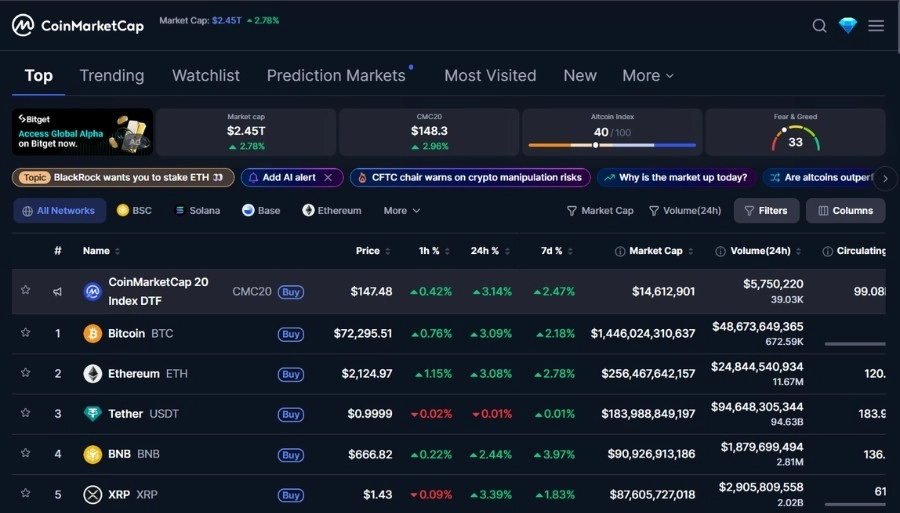
CoinMarketCap – One of the most widely used platforms for tracking cryptocurrency market data. It provides key metrics such as circulating supply, total supply, market capitalization, fully diluted valuation (FDV), and trading volume, helping users quickly understand a token’s market position.
CoinGecko – A popular alternative that offers similar market data along with additional insights such as developer activity, community growth, and exchange listings. It is often used to compare different crypto projects.
Token Unlocks – A specialized platform that tracks token vesting schedules and upcoming unlock events. This helps investors anticipate when large amounts of tokens may enter circulation and potentially impact market supply.
Arbiscan – A blockchain explorer that allows users to verify token information directly on-chain. Users can check token contracts, monitor wallet balances, and review transaction histories for tokens built on the Arbitrum network.
Using these tools together allows investors to cross-check tokenomics data and gain a clearer understanding of how a token functions within its ecosystem.
CoinMarketCap – One of the most widely used platforms for tracking cryptocurrency market data
Conclusion
Understanding tokenomics is an essential step when evaluating any cryptocurrency project. While price movements often attract the most attention, the long-term value of a token is heavily influenced by how its economic model is designed.
By learning how to read tokenomics, investors can better understand important factors such as token supply, distribution, vesting schedules, and real utility within an ecosystem. These elements help reveal whether a project is structured for sustainable growth or short-term speculation.
A well-designed token economy typically balances incentives between the team, the community, and the broader ecosystem while managing supply growth carefully. By applying the framework discussed in this guide, readers can more confidently analyze tokenomics and make more informed decisions when exploring new crypto projects.