Real World Assets (RWAs) have become one of the strongest narratives in the crypto market. Instead of focusing only on digital-native assets, RWA projects bring traditional financial products such as bonds, real estate, commodities, and private credit onto the blockchain. This allows investors to gain exposure to real-world value while benefiting from the transparency and efficiency of blockchain technology.
As institutional adoption continues to grow, many investors are looking for the top Real World Assets coins and projects that could benefit from this trend. From infrastructure providers like Chainlink to tokenized treasury platforms like Ondo Finance, the RWA sector now includes a wide range of opportunities. In this article, we’ll explore the top 10 Real World Assets Coins, what makes them valuable, and which projects may play a major role in the future of tokenized finance.
What Makes a Good RWA Coin?
Not all RWA projects are equally strong. While many crypto projects claim to have exposure to real-world assets, only a few have built real products, attracted institutional partners, or created sustainable demand for their tokens.
When evaluating top Real World Assets coins, investors should consider several key factors:
- Real asset exposure: The project should have a clear connection to real-world assets such as government bonds, private credit, real estate, commodities, or tokenized securities.
- Strong institutional adoption: Projects with partnerships involving banks, asset managers, or large enterprises are often in a better position to grow.
- Useful token utility: A strong RWA coin should play an important role within the ecosystem, such as governance, staking, collateral, fee payments, or access to tokenized assets.
- Regulatory readiness: Since RWAs involve traditional financial assets, compliance is critical. Projects that prioritize legal frameworks and licensing may have a stronger long-term outlook.
- Liquidity and ecosystem growth: A good RWA project should have active trading volume, a growing user base, and expanding integrations across the crypto ecosystem.
By looking at these factors, investors can better identify which RWA projects have real long-term potential rather than simply following short-term hype.
Top 10 Real World Assets By Market Cap
Chainlink (LINK)
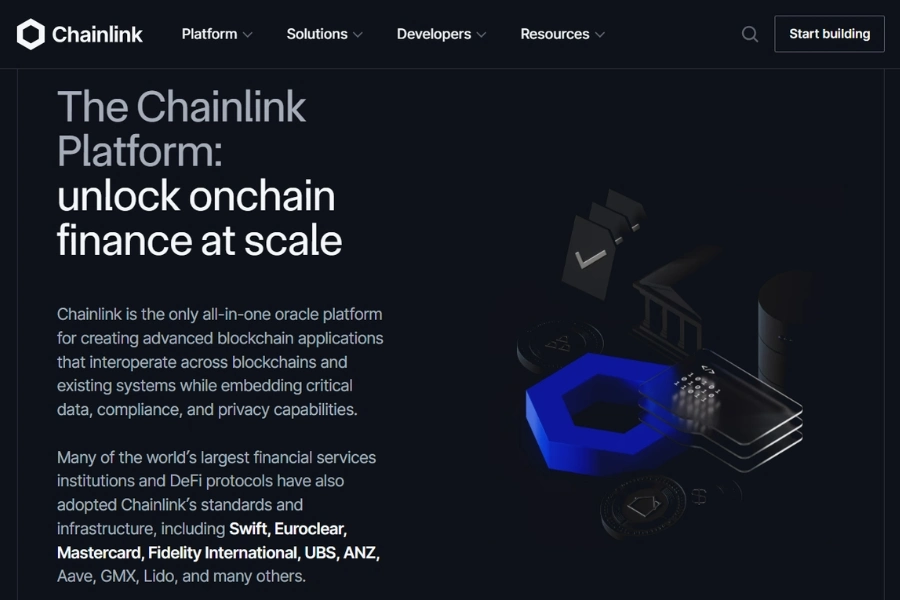
Chainlink is one of the most important infrastructure projects in the RWA sector because tokenized assets need reliable real-world data to function properly.
Blockchains cannot directly access off-chain information such as asset prices, interest rates, proof of reserves, or ownership records. Chainlink solves this problem through its decentralized oracle network, which delivers real-world data to smart contracts.
Instead of relying on a single provider, Chainlink uses multiple independent data sources to reduce manipulation risk and improve reliability. This is especially important for tokenized bonds, commodities, stocks, and other RWAs that require accurate external data.
Beyond price feeds, Chainlink also offers Proof of Reserve to verify asset backing and CCIP to support cross-chain movement of tokenized assets and data.
Key Features:
- Decentralized oracle network for real-world data
- Supports price feeds, interest rates, and proof of reserves
- Uses multiple data providers for stronger security
- Proof of Reserve verifies tokenized asset backing
- CCIP enables cross-chain interoperability
- LINK token rewards node operators and secures the network
Ondo Finance (ONDO)
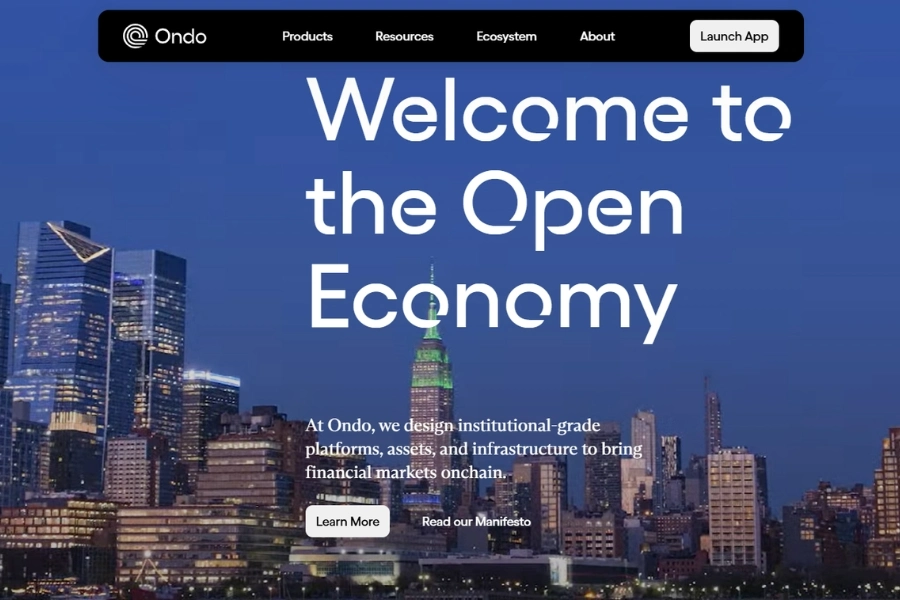
Ondo Finance is one of the most direct RWA investment plays in crypto because its business model is built around tokenizing traditional financial products.
The project is best known for offering blockchain-based access to U.S. Treasuries, money market funds, and other yield-generating assets.
This allows crypto users to earn relatively stable returns from traditional financial instruments without leaving the blockchain ecosystem.
Ondo has attracted significant attention because it focuses heavily on compliance, institutional-grade custody, and partnerships with established financial providers. Unlike many DeFi protocols that rely on crypto-native yields, Ondo’s products are backed by real-world financial assets.
This makes the project especially appealing during periods when investors want lower-risk exposure rather than purely speculative crypto assets. As demand for tokenized Treasuries and fixed-income products grows, Ondo is often viewed as one of the strongest RWA-focused projects in the market.
Key Features:
- Focuses on tokenized U.S. Treasuries and money market products
- Offers yield backed by traditional financial assets
- Strong institutional and compliance focus
- Uses regulated custodians and asset managers
- Provides lower-risk exposure compared to many DeFi protocols
MANTRA (OM)
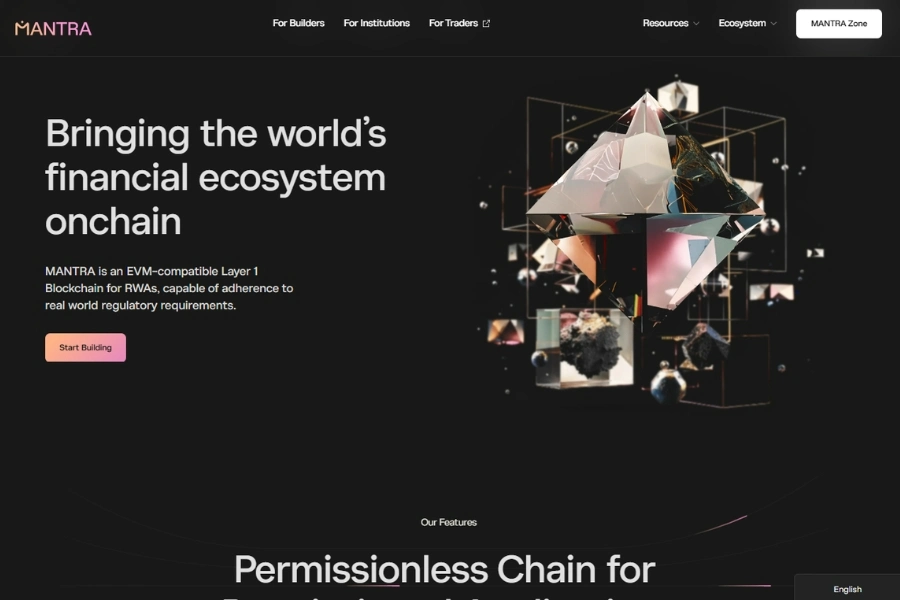
MANTRA is a Layer 1 blockchain built specifically for compliant RWA tokenization.
The project focuses on helping institutions tokenize regulated assets such as securities, real estate, private credit, and investment funds. Because many RWAs involve strict legal and regulatory requirements, MANTRA aims to provide the infrastructure needed for institutions to bring these assets on-chain safely.
One of its main advantages is its emphasis on identity verification, compliance, and permissioned access. This makes MANTRA more suitable for regulated markets than many traditional public blockchains.
As governments and financial institutions place greater focus on legal compliance, projects like MANTRA could become increasingly important in the RWA sector.
Key Features:
- Layer 1 blockchain built for RWAs
- Focuses on regulated asset tokenization
- Supports identity verification and KYC
- Designed for institutions and permissioned access
- Strong emphasis on legal compliance and regulation
Centrifuge is one of the earliest crypto projects focused on bringing real-world credit markets on-chain.
The platform allows businesses to tokenize assets such as invoices, trade receivables, loans, and private credit. These tokenized assets can then be used within DeFi to access liquidity or generate yield.
Centrifuge has become especially important in the RWA sector because it gives DeFi users exposure to income-generating assets that are not directly tied to crypto market volatility.
Over time, the project has expanded into tokenized funds and institutional asset management, while integrating with major DeFi protocols to improve liquidity and accessibility.
Key Features:
- Focuses on tokenized private credit and invoices
- Allows businesses to borrow against real-world assets
- Connects traditional finance with DeFi liquidity
- Supports tokenized funds and structured credit products
- Integrated with major DeFi lending platforms
Sky (formerly Maker, MKR)
Unlike many RWA projects that focus on tokenizing new assets, Sky uses real-world assets to strengthen an existing DeFi ecosystem.
The project behind the DAI stablecoin has increasingly integrated assets such as U.S. Treasuries, corporate bonds, and private credit into its collateral structure. This is important because it gives DAI exposure to more stable and predictable yield sources instead of relying entirely on volatile crypto collateral.
For Sky, RWAs are not just an additional feature—they have become one of the main drivers of revenue and stability within the ecosystem. Real-world yield generated from Treasury bills and other financial products helps support the protocol, strengthen DAI’s peg, and diversify risk.
This approach has made Sky one of the clearest examples of how traditional finance and DeFi can work together.
Key Features:
- Uses U.S. Treasuries and private credit as collateral
- Helps generate yield for the DAI ecosystem
- Reduces dependence on volatile crypto assets
- One of the largest DeFi protocols with RWA exposure
- Diversifies protocol revenue through real-world assetsư
Stellar (XLM)

Stellar is often seen as one of the most practical blockchain networks for tokenized assets and cross-border payments.
Unlike some RWA projects that focus mainly on investment products, Stellar is designed to move value efficiently between users, institutions, and financial systems. Its low fees and fast settlement times make it well suited for tokenizing fiat currencies, stablecoins, bonds, and other financial assets.
One of Stellar’s biggest strengths is its asset issuance framework, which allows institutions to create and transfer tokenized assets directly on the network. This makes Stellar useful for payment companies, remittance providers, and organizations looking to bring traditional assets on-chain.
Because of its focus on real-world payments and financial inclusion, Stellar has become a strong infrastructure layer for tokenized finance.
Key Features:
- Fast and low-cost blockchain for payments
- Supports tokenized fiat, stablecoins, and financial assets
- Built-in asset issuance functionality
- Strong focus on cross-border transfers
- Well-suited for remittance and payment use cases
Hedera (HBAR)
Hedera stands out from most RWA projects because it does not use a traditional blockchain architecture. Instead, it runs on Hashgraph, a technology designed to deliver faster transactions, lower latency, and higher scalability.
This makes Hedera particularly attractive for enterprise-grade tokenization, where large volumes of transactions may need to be processed quickly and efficiently.
Another reason Hedera is frequently mentioned in RWA discussions is its governance model. The network is overseen by a council of major global companies, including organizations such as Google, IBM, and Boeing. This structure gives Hedera a more enterprise-oriented image than many other crypto projects.
For institutions that care about trust, governance, and scalability, Hedera is often viewed as one of the strongest networks for large-scale RWA adoption.
Key Features:
- Uses Hashgraph instead of a traditional blockchain
- Offers fast transactions and low latency
- Highly scalable and energy-efficient
- Governed by major global enterprises
- Suitable for large-scale tokenization and enterprise use cases
XDC Network (XDC)
XDC Network focuses heavily on trade finance, making it one of the more specialized RWA projects in the market.
Trade finance is still a largely paper-based industry that involves invoices, bills of lading, letters of credit, and other business documents. XDC aims to bring these assets on-chain so they can be transferred, verified, and financed more efficiently.
The network is built with enterprise adoption in mind. It uses a hybrid architecture that combines public and private blockchain features, allowing businesses to keep sensitive information private while still benefiting from blockchain transparency and security.
Because trade finance is a multi-trillion-dollar market with significant inefficiencies, XDC is often viewed as one of the strongest blockchain projects for business-focused RWAs.
Key Features:
- Focused on trade finance and business assets
- Supports tokenization of invoices and trade documents
- Hybrid public-private blockchain architecture
- Designed for enterprise adoption
- Fast transactions with low fees
Algorand (ALGO)
Algorand is known for its high-speed infrastructure and efficient transaction settlement, which makes it a strong candidate for tokenized financial assets.
The network uses a Pure Proof-of-Stake consensus mechanism that enables fast finality, low fees, and strong scalability. These characteristics are especially important for institutions that need reliable infrastructure for tokenized bonds, securities, or payment systems.
Algorand has also been involved in several government and institutional blockchain initiatives, which has strengthened its reputation as a serious infrastructure project rather than a purely speculative crypto network.
For RWAs, speed and efficiency matter because tokenized assets often need to settle quickly and at low cost. Algorand’s architecture is built with these needs in mind.
Key Features:
- High-speed and low-cost blockchain
- Uses Pure Proof-of-Stake consensus
- Suitable for tokenized bonds and securities
- Fast settlement and strong scalability
- Attractive for institutional and government use cases
Quant (QNT)
Quant is different from many other RWA projects because it focuses on interoperability rather than tokenization itself.
As the RWA sector grows, tokenized assets are likely to exist across many different blockchains. Some institutions may use Ethereum, while others may prefer private chains, Layer 2 networks, or entirely different infrastructures.
Quant aims to solve this fragmentation problem through its Overledger technology, which allows applications and assets to move across different blockchain networks.
This could become increasingly important in the future because institutions will likely need a way to transfer tokenized assets between different ecosystems without being locked into a single chain.
Key Features:
- Focuses on interoperability between blockchains
- Uses Overledger technology to connect networks
- Helps tokenized assets move across ecosystems
- Reduces fragmentation in the RWA sector
- Important for institutional cross-chain infrastructure
Emerging RWA Projects to Watch
While the largest RWA coins tend to receive the most attention, several smaller projects are also building interesting solutions in the sector.
- Goldfinch focuses on decentralized lending without requiring crypto collateral. Instead, it connects borrowers in the real world with on-chain capital providers.
- TrueFi specializes in uncollateralized lending and institutional credit markets, making it one of the more finance-focused RWA projects.
- Maple Finance provides institutional lending infrastructure and has become a major player in on-chain credit.
- Polymesh is designed specifically for regulated securities and tokenized financial products, with a strong focus on compliance.
- Realio focuses on tokenized real estate and private equity, two of the most discussed areas within the RWA market.
These projects are smaller than the leading RWA coins, but they may still play an important role as tokenized finance continues to evolve.
Conclusion
Real World Assets are becoming one of the most important sectors in crypto because they connect blockchain technology with traditional financial products.
From infrastructure providers like Chainlink to tokenized Treasury platforms like Ondo Finance, the RWA market now includes a wide range of projects with different use cases.
Some projects focus on data, interoperability, and payments, while others focus directly on tokenizing bonds, private credit, real estate, or trade finance assets.
As institutional adoption grows, the RWA sector may continue expanding rapidly. However, investors should still evaluate each project carefully, paying close attention to regulation, token utility, adoption, and long-term sustainability.
Rather than relying on a single project, a diversified approach across different parts of the RWA ecosystem may provide better exposure to the long-term growth of tokenized finance.
FAQs
Q1. What are RWA coins?
RWA coins are cryptocurrencies connected to Real World Assets, such as government bonds, private credit, real estate, commodities, or trade finance products. Some RWA coins directly represent tokenized assets, while others provide infrastructure for the RWA ecosystem.
Q2. What is the best RWA crypto?
There is no single best RWA crypto because different projects focus on different areas. Ondo Finance is popular for tokenized Treasuries, Chainlink is important for data infrastructure, and Maker is known for integrating RWAs into DeFi.
Q3. Is Chainlink an RWA coin?
Yes, Chainlink is often considered an RWA coin because it provides the oracle infrastructure needed for tokenized assets to access real-world data.
Q4. Are RWA projects a good investment?
RWA projects may have strong long-term potential because they connect traditional finance with blockchain technology. However, they also carry risks related to regulation, liquidity, custody, and market volatility.
Q5. What is the difference between RWA projects and DeFi projects?
Traditional DeFi projects mainly focus on crypto-native assets, while RWA projects involve tokenized versions of real-world assets such as bonds, loans, or real estate. Some projects, like Maker and Centrifuge, combine both DeFi and RWAs.