Bitcoin halving is one of the most significant events built into the Bitcoin network. Roughly every four years, the reward that miners receive for adding new blocks to the blockchain is cut in half. This mechanism directly controls how new bitcoins enter circulation and plays a central role in Bitcoin’s fixed supply model of 21 million coins. Unlike traditional monetary systems, where supply can expand based on policy decisions, Bitcoin follows a transparent, pre-defined issuance schedule.
But why does bitcoin halving matter so much to investors, miners, and the broader crypto market? How does it affect price, mining profitability, and long-term scarcity? In this guide, we’ll break down all of them. Let’s dive in!
What Is Bitcoin Halving?
Bitcoin halving is a pre-programmed event in the Bitcoin protocol that reduces the block reward given to miners by 50%. The block reward is the amount of new bitcoins created and awarded to miners for successfully validating transactions and adding a new block to the blockchain.
When Bitcoin launched in 2009, miners received 50 BTC per block. After the first halving event in 2012, that reward dropped to 25 BTC. It was reduced again to 12.5 BTC in 2016, then to 6.25 BTC in 2020, and most recently to 3.125 BTC in April 2024. This process will continue until the maximum supply of 21 million bitcoins is reached, which is expected around the year 2140.
Bitcoin halving is not triggered by a calendar date. Instead, it occurs every 210,000 blocks, which translates to roughly four years based on Bitcoin’s average block time of about 10 minutes. Because this schedule is embedded in Bitcoin’s code, it cannot be changed without consensus from the network.
By systematically reducing new supply, bitcoin halving enforces scarcity and ensures that Bitcoin’s issuance rate declines over time — a key feature that distinguishes it from inflationary fiat currencies.
Why Does Bitcoin Halving Happen?
Bitcoin halving exists because it is part of Bitcoin’s original monetary design. When Satoshi Nakamoto created Bitcoin, the objective was to establish a predictable and transparent issuance schedule that could not be altered by governments, central banks, or centralized authorities. Halving is the mechanism that enforces long-term supply control.
Unlike fiat currencies, which can expand through monetary policy decisions, Bitcoin follows a fixed supply cap of 21 million coins. Halving ensures that new bitcoin issuance slows down over time, reducing inflation in a structured and mathematically predictable way. In Bitcoin’s early years, inflation was high because block rewards were large. As halvings occur, the rate of new supply entering circulation declines significantly.
This gradual reduction mirrors the scarcity dynamics of commodities like gold, where extraction becomes increasingly difficult over time. However, unlike gold, Bitcoin’s supply schedule is fully transparent and algorithmically enforced. Every participant in the network knows exactly how many new bitcoins will be created and when future halvings will occur.
Bitcoin halving preserves scarcity, controls long-term inflation, and reinforces the integrity of Bitcoin’s monetary policy.
How Bitcoin Halving Works
Bitcoin halving is triggered automatically after every 210,000 blocks are added to the blockchain. Since a new block is mined approximately every 10 minutes, this milestone is reached roughly every four years. The event occurs at a specific block height, not on a fixed calendar date.
When a miner successfully validates transactions and adds a new block, they receive a block reward. This reward consists of two components: newly created bitcoins (the block subsidy) and transaction fees paid by users. During a halving event, only the block subsidy is reduced by 50%. Transaction fees remain unaffected.
For example:
- From 2009 to 2012, the reward was 50 BTC per block
- After the 2012 halving, it became 25 BTC
- In 2016, it dropped to 12.5 BTC
- In 2020, it fell to 6.25 BTC
- In April 2024 (block 840,000), it was reduced to 3.125 BTC
This reduction continues until the block subsidy eventually reaches zero. At that point—expected around the year 2140—miners will rely solely on transaction fees as their incentive to secure the network.
Because the halving is enforced by consensus rules embedded in Bitcoin’s protocol, it does not require human intervention. Every full node on the network validates the reward schedule, ensuring that no miner can create more bitcoin than allowed.

History of Bitcoin Halving Events
Since Bitcoin launched in 2009, there have been four halving events. Each one reduced the block reward by 50% and lowered the rate of new bitcoin entering circulation.
2012 Halving
- Date: November 28, 2012
- Block Height: 210,000
- Reward Change: 50 BTC → 25 BTC
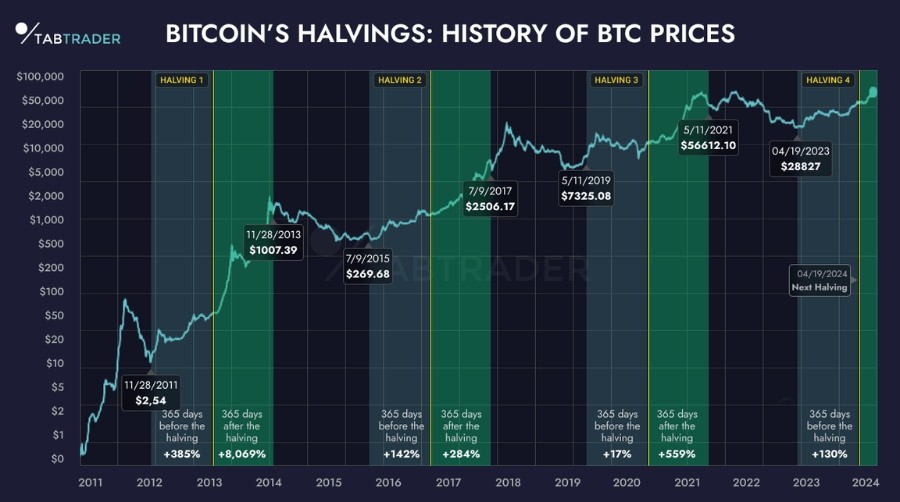
At the time of the first halving, Bitcoin was still a niche asset with relatively low liquidity and adoption. The price was around $12 before the event. In the year that followed, Bitcoin experienced a major bull run, eventually reaching over $1,000 in late 2013. While the halving reduced supply issuance, broader adoption and speculation also played significant roles in the price increase.
2016 Halving
- Date: July 9, 2016
- Block Height: 420,000
- Reward Change: 25 BTC → 12.5 BTC
Before the 2016 halving, Bitcoin was trading around $650. Over the following 18 months, the market entered another major bull cycle, culminating in the 2017 peak near $20,000. As with previous cycles, the halving reduced new supply, but price movements were also influenced by increased retail participation, ICO activity, and global market attention.
2020 Halving
- Date: May 11, 2020
- Block Height: 630,000
- Reward Change: 12.5 BTC → 6.25 BTC
The third halving occurred during the COVID-19 pandemic. Bitcoin was trading around $8,500 at the time. In the months that followed, institutional interest accelerated, and Bitcoin eventually reached a new all-time high near $69,000 in November 2021. Reduced issuance, growing institutional adoption, and macroeconomic factors all contributed to this cycle.
2024 Halving
- Date: April 20, 2024
- Block Height: 840,000
- Reward Change: 6.25 BTC → 3.125 BTC
The most recent halving further reduced Bitcoin’s annual issuance rate. At this stage, the majority of the total 21 million BTC supply has already been mined, meaning future supply growth will continue to slow. Market conditions around the 2024 halving included the approval of spot Bitcoin ETFs in the United States earlier that year, which significantly increased institutional exposure.
How Bitcoin Halving Affects Price
Bitcoin halving directly reduces the rate at which new bitcoins enter circulation. When block rewards are cut in half, the daily supply of newly mined BTC decreases immediately. If demand remains constant or increases while new supply declines, basic supply-and-demand dynamics suggest upward pressure on price over time.
Historically, each halving has been followed by a major market cycle. After the 2012, 2016, and 2020 halvings, Bitcoin eventually reached new all-time highs within the following 12 to 18 months. However, it is important to understand that halving does not trigger instant price increases. In past cycles, significant volatility occurred both before and after the event.
Several factors influence how bitcoin halving impacts price:
- Reduced Issuance: Fewer new coins entering the market can reduce sell pressure from miners.
- Market Expectations: Investors often anticipate halving events well in advance, which can lead to price movements before the actual block height is reached.
- Macro Conditions: Liquidity, monetary policy, institutional adoption, and regulatory developments also play critical roles.
- Speculative Cycles: Bitcoin markets are influenced by sentiment and capital rotation within the broader crypto ecosystem.
While halving tightens supply growth, it does not guarantee price appreciation. Bitcoin remains a volatile asset, and market outcomes depend on a combination of supply dynamics, demand trends, and broader economic conditions.
Impact on Bitcoin Miners
Bitcoin halving has a direct and immediate impact on miners because their primary revenue source — the block reward — is cut in half overnight.
When a halving occurs, miners receive 50% fewer bitcoins for validating the same amount of work. For example, after the 2024 halving, the reward dropped from 6.25 BTC to 3.125 BTC per block. If Bitcoin’s price does not rise proportionally, miners’ revenue in USD terms declines significantly.
Profitability Pressure
Mining is a capital-intensive business. Costs include:
- Electricity
- Mining hardware (ASICs)
- Cooling infrastructure
- Maintenance and operations
After a halving, less efficient miners with higher electricity costs may struggle to remain profitable. This often leads to:
- Older machines being shut down
- Smaller operators exiting the market
- Consolidation toward larger, more efficient mining firms
Hash Rate Adjustments
If a large number of miners shut down, Bitcoin’s total hash rate can temporarily decrease. However, Bitcoin’s difficulty adjustment mechanism automatically recalibrates approximately every two weeks.
This ensures:
- Blocks continue to be produced roughly every 10 minutes
- Network security remains stable
- Mining difficulty adapts to active participation
Over time, inefficient miners are filtered out, and the network stabilizes at a new equilibrium.
Shift Toward Transaction Fees
As block rewards decrease every four years, transaction fees become increasingly important to miner revenue.
In the long term:
- Bitcoin will rely more heavily on fee-based incentives
- Mining economics will depend on network usage and transaction demand
- Sustainable security will be tied to real on-chain activity
This gradual transition is part of Bitcoin’s long-term design. As the total supply approaches 21 million BTC, newly issued coins will represent a smaller and smaller portion of miner income.
Why Bitcoin Halving Matters for Investors
Bitcoin halving is one of the few predictable events in global finance. Unlike central bank policy decisions or corporate earnings, Bitcoin’s monetary schedule is fixed in code. That predictability makes halving especially important for long-term investors.
Increasing Scarcity Over Time
Every halving reduces the rate of new supply issuance. As fewer new bitcoins enter circulation, Bitcoin’s inflation rate declines.
After the 2024 halving:
- Annual issuance dropped significantly
- Bitcoin’s inflation rate fell below many fiat currencies
- The asset moved closer to its fixed maximum supply of 21 million BTC
For investors who view Bitcoin as “digital gold,” halving reinforces its scarcity narrative.
Cycle Awareness
Historically, Bitcoin has moved in roughly four-year cycles, often aligned with halving events:
- Accumulation phase before halving
- Expansion phase after halving
- Speculative peak
Multi-month correction or bear market
While history does not guarantee repetition, many investors monitor halving cycles as part of broader market timing strategies.
Risk and Volatility
Halving does not eliminate risk. Bitcoin remains highly volatile, and price movements can be extreme in both directions.
Key considerations:
- Markets often price in the halving months in advance
- Macroeconomic conditions can override supply dynamics
- Regulatory developments can impact capital flows
Halving strengthens the long-term supply thesis, but short-term outcomes remain uncertain.
Long-Term Monetary Thesis
For long-term holders, halving represents the gradual tightening of Bitcoin’s monetary policy. Unlike fiat currencies, which can expand supply based on policy decisions, Bitcoin’s issuance schedule becomes increasingly restrictive over time.
This predictable supply curve is central to Bitcoin’s identity as a decentralized, non-sovereign monetary asset.
Read more: Top 8 Ways to Earn Free Crypto Effortlessly in 2025
Future Halvings and Long-Term Outlook
Bitcoin halving will continue approximately every four years until the maximum supply of 21 million BTC is reached. This process is expected to continue until around the year 2140, when the final bitcoin is mined.
Gradually Declining Issuance
Each halving reduces block rewards by 50%:
- 2024: 3.125 BTC per block
- 2028 (estimated): 1.5625 BTC
- 2032 (estimated): 0.78125 BTC
- And so on
Over time, newly issued bitcoins will represent an increasingly small fraction of total circulating supply. Eventually, annual issuance will become negligible.
This creates a structurally deflationary supply curve — not because coins disappear, but because supply growth asymptotically approaches zero.
Transition to Fee-Based Security
As block rewards shrink, transaction fees are expected to become the primary incentive for miners.
For the network to remain secure long-term:
- Bitcoin must sustain meaningful on-chain transaction demand
- Users must be willing to pay fees for block space
- The fee market must compensate miners sufficiently
The long-term sustainability of Bitcoin’s security model depends on this transition functioning effectively.
Diminishing Impact Over Time?
There is an ongoing debate about whether future halvings will have the same market impact as early ones.
In earlier cycles:
- Supply shocks were proportionally large relative to market size
- Bitcoin was smaller and more sensitive to structural changes
As the asset matures:
- Market depth increases
- Institutional participation grows
- The relative supply reduction becomes smaller compared to the total circulating supply
This could mean future halvings have a more muted effect compared to the dramatic cycles of the past.
Bitcoin’s Long-Term Monetary Design
Bitcoin halving is not a short-term event — it is part of a century-long monetary schedule. The mechanism ensures:
- Predictable issuance
- Transparent supply policy
- Resistance to discretionary inflation
Whether viewed as digital gold, a hedge asset, or a decentralized monetary network, halving remains central to Bitcoin’s long-term economic structure.
Learn more: What Are Crypto Nodes? How They Power Blockchain Networks
FAQs
1. What is Bitcoin halving?
Bitcoin halving is a pre-programmed event that reduces the block reward given to miners by 50%. It occurs approximately every four years, or every 210,000 blocks, and is built into Bitcoin’s code to control supply issuance.
2. Why does Bitcoin halving happen?
Halving exists to enforce Bitcoin’s fixed maximum supply of 21 million BTC. By reducing new issuance over time, the protocol ensures predictable scarcity and gradually lowers inflation.
3. Does Bitcoin price always go up after a halving?
Not immediately — and not guaranteed.
Historically, previous halvings have been followed by major bull cycles within 12–18 months. However:
- Price movements are influenced by demand, macroeconomics, and market sentiment
- Volatility is common before and after halving events
- Past performance does not guarantee future results
Halving reduces supply growth, but price depends on demand dynamics.
4. How often does Bitcoin halving occur?
Approximately every four years. The exact timing depends on block production speed, since halvings are triggered by block height rather than calendar date.
5. What happens when all 21 million bitcoins are mined?
The final bitcoin is expected to be mined around the year 2140.
After that:
- No new BTC will be created
- Miners will earn revenue solely from transaction fees
- The network will rely entirely on fee-based incentives for security
6. Is Bitcoin halving good or bad for miners?
It depends on efficiency and market conditions.
Halving cuts miner rewards in half, which can:
- Reduce profitability
- Force inefficient miners to shut down
- Encourage consolidation
However, if Bitcoin’s price rises significantly after halving, miners may recover revenue despite reduced rewards.
7. Can Bitcoin halving be changed?
In theory, Bitcoin’s code could be modified through consensus. In practice, changing the halving schedule would require overwhelming agreement across the decentralized network — miners, nodes, developers, and users.
Given Bitcoin’s strong emphasis on monetary predictability, such a change is extremely unlikely.